
Release Notes#
Upcoming Release#
Important: PyPSA-Eur now uses a validation schema for configuration files. The schema also contains the default values for all known configuration options, which means config/config.default.yaml still exists and can be used, but will be automatically exported from the schema. Changes to the default config, therefore now require the schema to be updated. Find a detailed explanation in the contributors documentation.
Fix building osm network using overpass API (PyPSA/pypsa-eur#1940).
Added configuration option to set overpass API URL, maximum retries, timeout and user agent information (PyPSA/pypsa-eur#1940 and https://pypsa-eur.readthedocs.io/en/latest/configuration.html#overpass_api). For a list of public overpass APIs see here.
Refactored solve_network.py and solve_operations_network.py to separate optimization problem preparation from solving, enabling inspection of optimization problems before solve execution.
Added example configurations for rolling horizon and iterative optimization modes in config/examples/.
Added existing biomass decentral/rural residential and services heating capacity.
Fix parsing in Swiss passenger cars data (PyPSA/pypsa-eur#1934 and PyPSA/pypsa-eur#1936).
Fix: ValueError with cop_heat_pump in prepare_sector_network.py if tim_dep_hp_cop is false.
Fixed OSM raw data cleaning to include section line relation role.
Fixed missing raw OSM HVDC links defined using the
power=circuittag (NOTE:type=route``+``route=poweris deprecated).Fixed bugs with load shedding due to incorrect use of sign argument in n.add and np.isscalar (PyPSA/pypsa-eur#1908).
chore: disable PTES dynamic capacity by default
Add CO2 emission prices configurable per planning horizon for sector-coupled models. The CO2 price is added as a marginal cost on the co2 atmosphere Store.
Add custom storage plugin to handle retrievals from zenodo to address recurring failures.
Move to [pixi](https://pixi.sh/latest/) for robust cross-platform dependency management.
Fix: Allocate heat pump CAPEX on heat instead of electricity bus instead and remove nominal efficiency from CAPEX calculation
Fix: Configsettings for heat_pump_cop_approximation are now correctly passed to CentralHeatingCopApproximator.py
Fix: Allocate heat pump CAPEX on heat instead of electricity bus instead and remove nominal efficiency from CAPEX calculation
Fix: Configsettings for heat_pump_cop_approximation are now correctly passed to CentralHeatingCopApproximator.py
Fix: Deprecation warnings from pandas>=2.3.0 (PyPSA/pypsa-eur#1898)
Feature: Introduce a new method to overwrite costs (PyPSA/pypsa-eur#1752, PyPSA/pypsa-eur#1879). Modifications to the default techno-economic assumptions can now be configured via costs:custom_cost_fn, which applies changes to the resources/costs_{planning_horizons}.csv files. The default configuration includes minor adjustments to stabilize optimization results. The existing implementation via costs:overwrites and costs:capital_cost/costs:marginal_cost parameters remains available but will be deprecated in a future release.
Fixed AttributeError in prepare_sector_network.py when running sector-coupled PyPSA-Eur with only one country and cluster. (PyPSA/pypsa-eur#1835)
Added river-water and sea-water sourced heat pumps as well as interactive bus-balance plots and heat-source maps. Also introduced district heating areas in which heat sources must be located.
Added automatic retry for some (Zenodo) HTTP requests to handle transient errors like rate limiting and server errors.
Fixed ValueError in prepare_sector_network.py in function add_storage_and_grids when running with few nodes such that they are all already connected by existing gas lines. (PyPSA/pypsa-eur#1780)
Fixed AttributeError in prepare_sector_network.py when running sector-coupled PyPSA-Eur with only one country. (PyPSA/pypsa-eur#1778)
Fixed FileNotFoundError bugs preventing pypsa from being run as a Snakemake module. The cause of this bug was that intermediate zip files in rules were being saved in directories that didn’t exist yet (without creating the parent directories). This didn’t fail when using PyPSA-Eur as a standalone module, because the directory was the same as the rule’s output file. However, when using PyPSA-Eur as a Snakemake module, this was not the case as Snakemake prepends a prefix to all the input and output files, but not to any file locations listed as parameters. The fix was to save intermediate zip files at the top directory level. This was fixed for many rules in retrieve.smk, i.e., retrieve_eez, retrieve_nuts_2021_shapes, retrieve_nuts_2013_shapes, retrieve_worldbank_urban_population, retrieve_co2stop, download_wdpa, download_wdpa_marine, retrieve_eurostat_data. (PyPSA/pypsa-eur#1768)
Updated standing losses for PTES, central TTES, and decentral TTES, previously calculated using the
tes_tauparameter, to the latest DEA technology data, and updated costs version to v0.13.3.Introduce a new base network using TYNDP 2024 data (PyPSA/pypsa-eur#1646). This base network can be used with tyndp as base_network. It models NTC transmission capacities between TYNDP bidding zones using unidirectional links. This implementation neglects KVL and is referred to as a transport model. This is consistent with the TYNDP 2024 methodology.
Fixed missing costs name for geothermal-sourced heat pump and allowed geothermal heat pumps in test configs.
Changed error handling for non-extendable heat storage in energy-to-power ratio constraints to warning.
Allow expandable CCGTs by default
Updated build_osm_network and clean_osm_data to handle voltage levels below 220 kV (down to 63 kV). When base_network is set to osm_raw, an electricity grid from voltage levels AC 63 kV to 750 kV can be created (experimental feature). For an example, see the example configuration in config/examples/config-distribution-grid-experimental.yaml.
Fix retrieve_eurostat_data and retrieve_eurostat_household_data on Windows by avoiding a double access to a temporary file. (PyPSA/pypsa-eur#1825)
Added integration with the OETC platform
Remove pinned environment files mention in the pre-commit-config-yaml (PyPSA/pypsa-eur#1837)
Increase minimum required pypsa version to 0.33.2 (PyPSA/pypsa-eur#1849)
Running perfect foresight is now marked as unstable and may not work as expected.
Add residential heat demand-side management (DSM) based on smartEn study methodology. See new settings under sector: residential_heat.
Remove the hotfix in progress_retrieve and check that the directory exists (PyPSA/pypsa-eur#1840).
Added minimum unit dispatch setting option for electrolysis
Deprecate shared_cutouts: This configuration entry is no longer supported. Cutouts are always shared. To use scenario specific cutouts with different time or spatial resolution, make sure to name those cutouts differently in the atlite: configuration entry.
Move cutouts into data/cutouts/ directory for consistency. Note: This will trigger all cutouts to be re-downloaded or rebuild. If you need to retain downloaded cutouts, move them manually into data/cutouts/.
Deprecate the ability to determine
cutoutbounds based onregions_onshoreandregions_offshore. Insteadcutoutsneed to have their bounds explicitly defined in the configuration file.Moved configuration for
cutoutpreparation into a nested dictionaryprepare_kwargs. This allows to pass any keyword argument supported byatlite.Cutout.prepare()liketmpdir.Deprecate the configuration options
enable: retrieve,enable: retrieve_databundle, andenable: retrieve_cost_data. Instead, the rules are always included in the workflow. If no internet connection is available, the rules will fail.Misc: Empty folders that are automatically generated by
snakemakehave been added to the repository, e.g.resources/andresults/. Thepurgerule now removes their contents but keeps the folders (PyPSA/pypsa-eur#1764).Misc: Automatically update the DAGs shown in the documentation (PyPSA/pypsa-eur#1880).
PyPSA-Eur v2025.07.0 (11th July 2025)#
Features
Introduce the ability to use the bidding zones as administrative zones for the clustering. This also introduces the ability to create a custom
busmapfrom custombusshapes. To use bidding zones as clustering mode, abzmode has been introduced foradministrativeclustering. This feature is compatible with the general NUTS clustering approach. Custombusshapesmust be provided asdata/busshapes/base_s_{clusters}_{base_network}.geojson. (PyPSA/pypsa-eur#1578)Added aquifer thermal energy storage (ATES) to district heating. Some parameters (CAPEX, standing losses) might require tuning by the user. Eligibility computation is simplified. Turned off by default. (PyPSA/pypsa-eur#1665)
Added supplemental heating of thermal energy storage (PTES). This can be enabled by setting:
sector: district_heating: ptes: supplemental_heating:
true
. To enable a boosting heat pump as the supplemental heating technology, use:sector: district_heating: ptes: supplemental_heating: booster_heat_pump: true. (PyPSA/pypsa-eur#1692)
Breaking Changes
Consolidated gap-filling strategies options under a new configuration section load: fill_gaps. (PyPSA/pypsa-eur#1677)
Replaced pinned environment files with conda-lock generated lock files for better dependency resolution and cross-platform reproducibility. Deprecated old
-pinned.yamlfiles with migration instructions. These files will not be updated anymore and will be removed in a future release. (PyPSA/pypsa-eur#1660)
Changes
Adjusted a series of default values in
config.default.yaml.Non-sequestered high-value chemicals (e.g. plastic waste) is now allocated based on the population instead of production. It can be either burned without energetic utilization or, optionally, in CHPs. (PyPSA/pypsa-eur#1625)
Allow district heating potentials to be specified as a dictionary, with country codes as keys for district_heating: potential:. (PyPSA/pypsa-eur#1742)
Added configuration option for setting
links: p_min_pu. (PyPSA/pypsa-eur#1637)Use of
agg_p_nom_limitsnow allows aggregating allsolarelectric technologies. Offshore floating wind (offwind-float) was added. (PyPSA/pypsa-eur#1725, PyPSA/pypsa-eur#1727)The file
config/config.yamlis now fully optional. (PyPSA/pypsa-eur#1745)Small plotting improvements. (PyPSA/pypsa-eur#1727)
The plotting|map|color_geomap was renamed to plotting|map|geomap_colors to align with the new PyPSA API.
Bugfixes and Compatibility
Select correct capital costs for floating offshore wind. Previously, the same as for offshore wind were used. (PyPSA/pypsa-eur#1701)
Efficiency correction for electrobiofuels. (PyPSA/pypsa-eur#1683)
Configuration settings for heat pump COP approximation are now correctly used. (PyPSA/pypsa-eur#1729)
In
add_existing_baseyear, renewable carriers are only added if listed inelectricity: renewable_carriers:. (PyPSA/pypsa-eur#1717)Ensure that distribution losses are only deducted from electricity demand when distribution losses are modelled. (PyPSA/pypsa-eur#1668)
Sanitize columns in
add_brownfield. (PyPSA/pypsa-eur#1676)Adjustments to upcoming PyPSA API changes. (PyPSA/pypsa-eur#1720, PyPSA/pypsa-eur#1750)
Ensure consistent use of wildcards in
build_renewable_profilesforrun: shared_resources: policy: base. (PyPSA/pypsa-eur#1641)Ensure solver logs are written to file. (PyPSA/pypsa-eur#1684)
DAG generation (rulegraph and filegraph) now correctly utilizes all configuration sources (default, file-based, and command-line overrides), resolving an issue where visualizations could misrepresent the actual workflow execution plan. SVG output format has also been added for these graphs, and error handling during graph generation has been enhanced. (PyPSA/pypsa-eur#1678)
Chore: Replace licensing information in
.reuse/dep5withREUSE.tomlto be compliant with REUSE 3.2 (https://reuse.software/spec-3.2/#licensing-information). (PyPSA/pypsa-eur#1739)Windows compatibility improvements. (PyPSA/pypsa-eur#1602, PyPSA/pypsa-eur#1702)
Developers Note
Scripts now use absolute imports. When using
mock_snakemake, adding the working directory to the PYTHONPATH or in your IDE is required. (PyPSA/pypsa-eur#1643)
PyPSA-Eur v2025.04.0 (6th April 2025)#
Features
Allowing network clustering based on administrative boundaries (i.e., NUTS0/country-level to NUTS3). To make use of this setting, set
clustering: mode: administrativeandscenario: clusters: ["adm"]. Optionally, include a dictionary of individual country codes and their target NUTS level resolution (0 to 3). Note that non-NUTS countries ‘BA’, ‘MD’, ‘UA’, and ‘XK’ can only be clustered to level 0 and 1. (PyPSA/pypsa-eur#1502, PyPSA/pypsa-eur#1580)Moved setting
enable: custom_busmaptoclustering: mode: custom_busmap.
Added support for spanning multiple consecutive, non-consecutive or meteorological (July-June) weather years in one optimisation model. The annualised capital costs, energy limits and loads are multiplied by the number of years. To calculate the total annualised system costs, divide the total costs by the number of years. To include multiple years, configure the range in
snapshots:and provide the list of associated cutouts inatlite: default_cutouts:. (PyPSA/pypsa-eur#1613)All cutout references in
config.default.yamlcan now be specified by a list of cutouts which will be concatenated along the time dimension.All cutout references in
config.default.yamlnow default toatlite: default_cutout:.In
build_hydro_profile, when subannual periods are used but full-year cutouts are available, the hydro profile is now first calculated for the full year(s) and then sliced to the subannual periods. This is to align better with the normalization process that uses annual EIA statistics.In
time_aggregation, the resampling will now be applied separately for each year covered in the snapshots. This prevents snapshots that overflow into the next year, which simplifies running non-contiguous periods.The files
data/era5-annual-{HDD,runoff}-per-country.csvare now daily resolved and were moved into the data bundledata/bundle/era5-{HDD,runoff}-per-country.csv.
Support for multiple resource classes for wind and solar to use more accurate renewable potentials and time series when the spatial resolution is low (PyPSA/pypsa-eur#1481):
Splits renewable potentials and time series into a configurable number of resource classes per carrier and clustered region. The binning is linear based on the average capacity factors.
With the setting
renewables: onwind: resource_classes: 4, each region would have four onshore wind generators, each with different potential (p_nom_max) and capacity factor (p_max_pu). The same applies to solar PV and offshore wind.The default number of resource classes is kept at one per cluster.
In
build_renewable_profiles, a new dimension “bin” is added to the output (xarray.Dataset). The resource classes are numbered from 0 (lowest) to N (highest).Additionally, a new
.geojsonfile of clustered regions split by resource classes is exported, which is is used inadd_electricityandbuild_clustered_solar_rooftop_potentialsto assign existing wind and solar capacities to the correct combination of bus and resource class. Within a clustered region, the resource classes do not have to be contiguous.
Added simplified representation of renewable energy imports (PyPSA/pypsa-eur#1583):
Can be activated with
sector: imports: enable: true.Allows hydrogen, ammonia, methanol, gas and Fischer-Tropsch oil with configurable prices (
sector: imports: prices:).Methane imports use existing LNG terminal entry points, hydrogen imports use existing pipeline entry points.
Simplification: Import prices are uniform across all regions.
Carbon content of imported fuels is handled like biomass.
Total volume of imports can be limited with
sector: imports: limit:. The limit includes synthetic and biomass imports (sector: solid_biomass_import:), but not fossil fuel imports.
Improved automated plotting of results (PyPSA/pypsa-eur#1589, PyPSA/pypsa-eur#1590, PyPSA/pypsa-eur#1626):
Moved plotting configuration from
config/config.default.yamltoconfig/plotting.default.yaml. The plotting configuration is now separated from the main configuration file.Added rule
plot_balance_mapsfor plotting energy balance maps. The plots are saved inresults/maps/*and can be configured inplotting.default.yamlunderplotting: balance_maps.Added new rule
plot_balance_timeseriesto plot energy balance time series for the whole year at daily resolution and for each month at model-native resolution.Added new rule
plot_heatmap_timeseriesfor plotting configuration of heatmap time series, including options for marginal prices, utilisation rates, and state of charge.
Extended pre-built weather data cutouts. Cutouts are now available for the years 1996, 2010, 2012, 2013, 2019, 2020 and 2023. (PyPSA/pypsa-eur#1559)
Added option to specify the cutout directory in the configuration file. This allows to the user to specify the directory where the cutouts are stored. Use it by setting
atlite: cutout_directory:in the configuration file. (PyPSA/pypsa-eur#1515)
Implemented an energy-to-power ratio constraint for thermal energy storage (TES), linking the storage capacity to the corresponding charger capacity. Additionally, chargers and dischargers are now sized proportionally through a unified constraint. (PyPSA/pypsa-eur#1546)
Added option to calculate dynamic storage capacities for pit thermal energy storage using the
e_max_puattribute. The dynamic capacities are calculated in the new rulebuild_tes_capacity_profiles. (PyPSA/pypsa-eur#1612)Added a configuration to disable transmission efficiency for some carriers. (PyPSA/pypsa-eur#1631)
Added the options to overwrite investment, lifetime, FOM, VOM, efficiency and fuel attributes from the configuration file under
costs: overwrites:. This mimics the existing capital and marginal cost behaviour. (PyPSA/pypsa-eur#1532, PyPSA/pypsa-eur#1565)Added rule
build_co2_sequestration_potentials, which processes the raw data from CO2Stop. Integrated from separate repository (ericzhou571/Co2Storage). (PyPSA/pypsa-eur#1606)Added option to pass
linopy.Modelkeyword arguments throughconfig.default.yaml. (PyPSA/pypsa-eur#1596)Added option to create
snakemake filegraphandsnakemake rulegraph. (PyPSA/pypsa-eur#1574)
Changes
Refactor of
make_summary(PyPSA/pypsa-eur#1573):Computes summaries for only a single network at a time.
Concatenation is outsourced to new rule
make_global_summary.Rule no longer depends on network plots; use the
allcollection rule to generate summaries and plots.Calculation of cumulative costs for myopic foresight networks was moved to
make_cumulative_costs.Rewrote functions in
make_summaryto use PyPSA statistics module more.Inferral of component locations was made more robust. The revised function uses
n.buses.locationrather than the index strings. Components inherit the location of the bus they connect to with the highest spatial resolution.The file
supply.csvwas removed; the fileprice_statistics.csvwas removed and integrated intometrics.csv; the filessupply_energy.csv,nodal_supply_energy.csv,cfs.csv,nodal_cfs.csvwere renamed toenergy_balance.csv,nodal_energy_balance.csv,capacity_factors.csv,nodal_capacity_factors.csv.The order of the MultiIndex levels changed but are now consistently named and documented; the index level “component” now uses capitalised component names rather than lower case list names (e.g. “Generator” instead of “generators”).
The plotting functions in
plot_summaryhave been updated to reflect the changes in the summary files.
Unified the functions
load_costsinadd_electricityandprepare_costsinprepare_sector_networkinto a single functionload_costsinadd_electricity. For sector-coupled networks, annualised investment costs are now referred to as “capital_cost” instead of “fixed”. (PyPSA/pypsa-eur#1566, PyPSA/pypsa-eur#1567)In
prepare_sector_network, split shipping and aviation sector fromadd_industry()into separate function and configuration setting. To mirror previous behaviour of settingsector: industry: true, also setsector: shipping: trueandsector: aviation: true. (PyPSA/pypsa-eur#1607)Replaced renewable capacity estimation from OPSD VRE data with an estimation based on Global Energy Monitor (GEM) data. The corresponding setting was renamed from
from_opsdtofrom_gem. (PyPSA/pypsa-eur#1481)Functionality reduction: The technology mapping from
powerplantmatchingnow has to be a 1:1 rather than a 1:n mapping. (PyPSA/pypsa-eur#1481)Geothermal heat potentials are now restricted to those in close proximity to future district heating areas as projected by Manz et al. 2024. (PyPSA/pypsa-eur#1516)
Introduced the option to vent heat in all heating systems at given marginal cost and added a small marginal cost for water tank charging to improve numerics. Renamed config setting for marginal cost of home-battery charging to
marginal_cost_home_battery_storage. (PyPSA/pypsa-eur#1563)Included the fuel name as part of the carrier attribute for CHP plants added in
prepare_sector_network. (PyPSA/pypsa-eur#1622)Updated EIA hydro-electricity statistics up to end of 2023. (PyPSA/pypsa-eur#1543)
Reduce pipeline entrypoints to country coverage. Exclude Russia and Belarus. (PyPSA/pypsa-eur#1582)
Rules of
validate.smkhave been removed to consolidate the volume of code to maintain. (PyPSA/pypsa-eur#1581)Use consistent function scope and avoid use of global variables to make functions in
add_*,prepare_*andsolve_*modular and portable. (PyPSA/pypsa-eur#1537, PyPSA/pypsa-eur#1549)Enable running
mock_snakemakefrom a separate working directory. (PyPSA/pypsa-eur#1571)Add customisable memory logging frequency for
solve_network. (PyPSA/pypsa-eur#1521)The
config/config.yamlwill no longer be created when running snakemake. It will still be used by the workflow if it exists, but ignored otherwise and is not required. See Configuration Files for more information. (PyPSA/pypsa-eur#1649)
Bugfixes and Compatibility
Support for Snakemake 9. This is the new minimum version. (PyPSA/pypsa-eur#1619)
Support newer HiGHS versions. (PyPSA/pypsa-eur#1528)
Use
pyscipoptfrom PyPI. (PyPSA/pypsa-eur#1524)Conda: Remove defaults channel from conda` setup and use strict channel priority. (PyPSA/pypsa-eur#1554)
Fail on solving status ‘warning’ because results are likely not valid. (PyPSA/pypsa-eur#1591)
Bugfix in
time_aggregation. The resampling produces a contiguous date range. In case the original index was not contiguous, all rows with zero weight must be dropped (corresponding to time steps not included in the original snapshots). (PyPSA/pypsa-eur#1613)Bugfix in
time_aggregation. Avoid that aggregated snapshot indices land on February 29th in leap years whenenable: drop_leap_day: true. (PyPSA/pypsa-eur#1613)Bugfix: Handled missing geothermal potential data for the United Kingdom if geothermal is included for direct utilisation or as heat pump source. The config parameter
sector: district_heating: limited_heat_sources: geothermal:
ignore_missing_regions
can be used to either terminate the workflow throwing an error (default:true) or assign 0 values to missing regions and continue the workflow (false). (PyPSA/pypsa-eur#1617)Bugfix: Changed setting
central_heat_vent(default:true), because the water tanks charger and discharger were used as heat vents. (PyPSA/pypsa-eur#1556)Bugfix: Fix
ifclause inprepare_sector_networkfunctionadd_methanol()(PyPSA/pypsa-eur#1632).Bugfix: Fix matching of Swiss regions (CH) in unsustainable biomass potential calculation. (PyPSA/pypsa-eur#1585)
Bugfix: Fix nuclear
p_max_putime series for greenfield nuclear. (PyPSA/pypsa-eur#1519)Bugfix: Ensure correct
dtypefor the “reversed” column of links. (PyPSA/pypsa-eur#1525)Bugfix: Ignore keyboard interrupt in memory logging subprocess. (PyPSA/pypsa-eur#1555)
Bugfix: Change WDPA download rules to use shutil instead of shell commands to properly function on Windows. (PyPSA/pypsa-eur#1575)
Bugfix: Added setting
run: use_shadow_directory:(default:true) which sets theshadowparameter of the snakemake workflow. Configuring totruesets snakemakeshadowparameter toshalloow,falseto Ǹone`. Should be set tofalsefor those cases, where snakemake has an issue with finding missing input/output files in solving rules. (PyPSA/pypsa-eur#1535)
PyPSA-Eur v2025.01.0 (24th January 2025)#
Note
With this version, PyPSA-Eur switches to CalVer versioning.
Features
Introduce geothermal district heating, including direct utilisation and heat pumps, using potentials from Manz et al. 2024: Spatial analysis of renewable and excess heat potentials for climate-neutral district heating in Europe. (PyPSA/pypsa-eur#1359)
Added option to reduce central heating forward temperatures by annual percentage (see rule
build_central_heating_temperature_profiles). This makes COP profiles and heat pump efficiencies planning-horizon-dependent. Myopic and perfect foresight modes were adjusted accordingly to update COPs of existing heat pumps in preceding years to adjusted temperatures. (PyPSA/pypsa-eur#1290)Allow CHPs to use different fuel sources such as gas, oil, coal, and methanol. Note that the cost assumptions are based on a gas CHP (except for solid biomass-fired CHP). (PyPSA/pypsa-eur#1392, PyPSA/pypsa-eur#1414)
Add a rule to create a filegraph dag and rename dag rule as rulegraph. (PyPSA/pypsa-eur#1574)
Breaking Changes
Rearranged workflow to cluster the electricity network before calculating renewable profiles and adding further electricity system components. (PyPSA/pypsa-eur#1201)
Moved rules
simplify_networkandcluster_networkbeforeadd_electricityandbuild_renewable_profiles.Split rule
build_renewable_profilesinto two separate rules,determine_availability_matrixfor land eligibility analysis andbuild_renewable_profiles, which now only computes the profiles and total potentials from the pre-computed availability matrix.Removed variables
weight,underwater_fraction, andpotentialfrom the output ofbuild_renewable_profilesas it is no longer needed.HAC-clustering is now based on wind speeds and irradiation time series rather than capacity factors of wind and solar power plants.
Added new rule
build_hac_featuresthat aggregates cutout weather data to base regions in preparation forcluster_network.Removed
{simpl}wildcard and all associated code of themsuffix of the{cluster}wildcard. This means that the option to pre-cluster the network insimplify_networkwas removed. It will be superseded by clustering renewable profiles and potentials within clustered regions by resource classes soon.Added new rule
add_transmission_projects_and_dlrwhich adds the outputs frombuild_line_ratingandbuild_transmission_projectsto the output ofbase_network.The rule
add_extra_componentswas integrated intoadd_electricityAdded new rule
build_electricity_demand_baseto determine the load distribution of the substations in the base network (which was previously done inadd_electricity). This time series is used as weights for kmeans-clustering incluster_networkand is later added to the network inadd_electricityin aggregated form.The weights of the kmeans clustering algorithm are now exclusively based on the load distribution. Previously, they also included the distribution of thermal capacity.
Since the networks no longer start with the whole electricity system added pre-clustering, the files have been renamed from
elec...nctobase...ncto identify them as derivatives ofbase.nc.The scripts
simplify_network.pyandcluster_network.pywere simplified to become less nested and profited from the removed need to deal with cost data.New configuration options to calculate connection costs of offshore wind plants. Offshore connection costs are now calculated based on the underwater distance to the shoreline plus a configurable
landfall_lengthwhich defaults to 10 km. Previously the distance to the region’s centroid was used, which is not practical when the regions are already aggregated.
Removed
{ll}wildcard. This is now a configuration optionelectricity: transmission_limit:, defaulting tovopt. All previous options of the{ll}wildcard are also now available within the{opts}wildcard (e.g. as-lv1.25-). (PyPSA/pypsa-eur#1472)Breaking change: The location of several network files has changed to distinguish more clearly between solved and unsolved networks. Unsolved networks that were previously stored in
results/{run}/prenetworksare now placed inresources/{run}/networks. Solved networks that were previously stored inresults/{run}/postnetworksare now stored inresults/{run}/networks. Brownfield networks are identified by a_brownfieldsuffix in their filename.Replaced the store representation of biogenic carriers (solid biomass, biogas, bioliquids, MSW) in
prepare_sector_networkwith generators using attributese_sum_minande_sum_maxto enforce minimum usage and limit maximum potential, respectively. (PyPSA/pypsa-eur#1373)Aligned the configuration setting for the CO2 network with other similar settings (changed from
co2networktoco2_network). (PyPSA/pypsa-eur#1438)Added options
biosng_ccandbiomass_to_liquid_ccto separate the base technology from the option to capture carbon from it. (PyPSA/pypsa-eur#1298)
Changes
The building process of the base network from OpenStreetMap was revised. The code was rewritten to improve the speed, accuracy and to preserve the topology including original substation locations, wherever possible. The latest
osm-prebuiltdata is version v0.6 at https://zenodo.org/records/14144752. (PyPSA/pypsa-eur#1384, PyPSA/pypsa-eur#1387, PyPSA/pypsa-eur#1431)The shapes for countries and administrative regions have been updated. The workflow has been modified to use higher resolution and more harmonised shapes (NUTS3 2021 01M data and OSM administration level 1 for non-NUTS3 countries, such as BA, MD, UA, and XK). Data sources for population and GDP per capita p.c. have been updated to JRC ARDECO, using values for 2019. The rule
build_gdp_pop_non_nuts3is now integrated intobuild_shapesand extended to build regional values for all non-NUTS3 countries. (PyPSA/pypsa-eur#1479)The default configuration for the emission reduction path in myopic pathway planning mode has been changed to align more closely with policy targets (
co2_budget:). (PyPSA/pypsa-eur#1399)Consider the planning horizon for biomass potentials calculation. Previously, the biomass potential year could be chosen independently of the current planning horizon. (PyPSA/pypsa-eur#1311)
Update locations and capacities of ammonia plants. (PyPSA/pypsa-eur#1471)
NEP transmission projects are updated to HTLS lines. (PyPSA/pypsa-eur#1348)
Added 98% imperfect capture rate of Allam cycle gas turbine. (PyPSA/pypsa-eur#1298)
Improved
sanitize_carrierfunction by filling in colors of missing carriers. (PyPSA/pypsa-eur#1400)In post-discretizing network elements, add a configuration option to allow a fractional last unit size. (PyPSA/pypsa-eur#1309)
Bugfixes and Compatibility
The length factor on the transmission lines haversine length was applied twice, once when calculating costs and once when clustering the network. Now it is only applied when calculating costs. (PyPSA/pypsa-eur#1511)
Vehicle-to-grid dispatch capacity is now limited by the fraction of vehicles participating in demand-side-management, halving the dispatch capacity under the default demand-side management participation rate of 0.5. (PyPSA/pypsa-eur#1423)
Demand for ammonia was double-counted at current/near-term planning horizons with
sector: ammonia: true. (PyPSA/pypsa-eur#1312)Duplicates found in
build_transmission_projectsare now correctly removed from the network. (PyPSA/pypsa-eur#1360)Ensure
s_max_puare correctly set for transmission projects. (PyPSA/pypsa-eur#1323)Correctly reduce gas pipeline retrofit potentials in myopic pathway planning mode. (PyPSA/pypsa-eur#1258)
The missing lifetime attribute was added to hydrogen steel tanks, which is important for pathway planning. (PyPSA/pypsa-eur#1510)
Ensure all links with capital costs have a lifetime. This is important for pathway planning. (PyPSA/pypsa-eur#1319)
Resolved a bug which occurred when multiple DC links are connected to the same DC bus and the DC bus is connected to an AC bus via a converter. In this case, the DC links were wrongly simplified, completely dropping the shared DC bus. (PyPSA/pypsa-eur#1381, PyPSA/pypsa-eur#1507)
Waste CHPs are now added only to buses with district heating. Previously they were added to all regions. (PyPSA/pypsa-eur#1407)
Fixed VOM, emissions and efficiencies of methanol-to-kerosene links. (PyPSA/pypsa-eur#1317, PyPSA/pypsa-eur#1320, PyPSA/pypsa-eur#1376)
Existing heating data in
build_existing_heating_distributionand the indexing of existing heat pumps for the COP correction inadd_brownfieldhave been adjusted so that myopic pathways work with the geothermal district heating. (PyPSA/pypsa-eur#1453)Adjusted
efficiency2(to atmosphere) for bioliquids-to-oil link inprepare_sector_networkto correctly offset the corresponding oil emissions. (PyPSA/pypsa-eur#1410)Add
{sector_opts}wildcard totime_aggregation. (PyPSA/pypsa-eur#1307)Resolved a problem where excluding certain countries from
countriesconfiguration led to clustering errors. (PyPSA/pypsa-eur#1308)The environment
envs/retrieve.yamlwas removed. Retrieval rules now useenvs/environment.yaml. (PyPSA/pypsa-eur#1509)Logging files are created more comprehensively. (PyPSA/pypsa-eur#1508, PyPSA/pypsa-eur#1421)
Link for monthly CO2 prices was fixed. (PyPSA/pypsa-eur#1485)
Current
rasterioversions supported. (PyPSA/pypsa-eur#1480)Compatibility with
powerplantmatching<=0.6. (PyPSA/pypsa-eur#1490)Compatibility with
pypsa==0.32. (PyPSA/pypsa-eur#1316, PyPSA/pypsa-eur#1445)Maximum
snakemakeversion is currently 8.24. (PyPSA/pypsa-eur#1440)Initial steps towards unit testing are taken. (PyPSA/pypsa-eur#1466, PyPSA/pypsa-eur#1438, PyPSA/pypsa-eur#1432)
The installation via
make
install
now prioritizesmambaovercondafor faster installation. Conda is still used as a fallback. The commandmake installnow also supports passing the name of the environment, e.g.make install name=my-project. (PyPSA/pypsa-eur#1461)Ruff is now used for linting and formatting. It is used within pre-commit, so no changes are needed. But we recommend to set it up locally as well. (PyPSA/pypsa-eur#1474)
Updating all base shapes (country_shapes, europe_shape, nuts3_shapes, …). The workflow has been modified to use higher resolution and more harmonised shapes (NUTS3 2021 01M data and OSM administration level 1 for non-NUTS3 countries, such as BA, MD, UA, and XK). Data sources for population and GDP p.c. have been updated to JRC ARDECO https://urban.jrc.ec.europa.eu/ardeco/ – 2019 values are used. build_gdp_pop_non_nuts3 (originally created to build regional GDP p.c. and population data for MD and UA) is now integrated into build_shapes and extended to build regional values for all non-NUTS3 countries using cutouts of the updated datasets GDP_per_capita_PPP_1990_2015_v2.nc and ppp_2019_1km_Aggregated.tif,
PyPSA-Eur 0.13.0 (13th September 2024)#
Features
Add new methanol-based technologies: methanol-to-power, methanol reforming, methanol-to-kerosene, methanol-to-olefins/aromatics, biomass-to-methanol with and without carbon capture. (PyPSA/pypsa-eur#1207)
Add function
modify_attributetoprepare_sector_networkwhich allows to adjust any attribute of any PyPSA component either by a multiplication with a factor or setting an absolute value. These adjustments can also depend on the planning horizons and are set in the config underadjustments. (PyPSA/pypsa-eur#1244)Add version control to osm-prebuilt:
config["electricity"]["osm-prebuilt-version"]. Defaults to latest Zenodo release, i.e. v0.4, Config is only considered when selectingosm-prebuiltasbase_network. (PyPSA/pypsa-eur#1293)
Changes
Use JRC-IDEES thermal energy service instead of final energy demand for buildings heating demand. Final energy includes losses in legacy equipment. Efficiencies of existing heating capacities are lowered according to the conversion of final energy to thermal energy service. For overnight scenarios or future planning horizons this change leads to a reduction in heat supply and, therefore, system cost. (PyPSA/pypsa-eur#1255)
Updated district heating supply temperatures based on `Euroheat's DHC Market Outlook 2024<https://api.euroheat.org/uploads/Market_Outlook_2024_beeecd62d4.pdf>`__ and AGFW-Hauptbericht 2022.
min_forward_temperatureandreturn_temperature(not given by Euroheat) are extrapolated based on German values. (PyPSA/pypsa-eur#1264)Refined implementation of unsustainable biomass. (PyPSA/pypsa-eur#1275, PyPSA/pypsa-eur#1271, PyPSA/pypsa-eur#1254, PyPSA/pypsa-eur#1266)
Biomass transport costs are now stored in the
datafolder. Extraction from PDF file is skipped. (PyPSA/pypsa-eur#1272)Increased the resolution of NUTS3 and NUTS2 shapes from 1:60M to 1:3M. The shapefiles are now directly retrieved with the
retrieve_nuts_shapesrule. (PyPSA/pypsa-eur#1286)Uses of Snakemake’s
storage()function are integrated into retrieval rules. This simplifies the use ofmock_snakemakeand places downloaded data more transparently into thedatadirectory. (PyPSA/pypsa-eur#1274)Updated data bundle to remove files which are now directly downloaded in the rules. This reduces the size of the data bundle. (PyPSA/pypsa-eur#1291)
Update NEP transmission projects to include Startnetz. (PyPSA/pypsa-eur#1263)
Auto-update
envs/environment.fixed.yaml. (PyPSA/pypsa-eur#1281)
Bugfixes and Compatibility
Updated osm-prebuilt network to version 0.4 (https://doi.org/10.5281/zenodo.13759222). Added Kosovo (XK) as dedicated region. Fixed major 330 kV line in Moldova (MD) (https://www.openstreetmap.org/way/33360284). (PyPSA/pypsa-eur#1293)
Made the overdimensioning factor for heating systems specific for central/decentral heating, defaults to no overdimensionining for central heating and no changes to decentral heating compared to previous version. (PyPSA/pypsa-eur#1259)
The carrier of stores was previously silently overwritten by their bus’ carrier when building global emission constraints. (PyPSA/pypsa-eur#1262)
The fossil oil generator was incorrectly dropped when
sector:
oil_refining_emissions
was greater than zero. (PyPSA/pypsa-eur#1257)Correctly account for the CO2 emissions of municipal solid waste. (PyPSA/pypsa-eur#1256)
Added a missing space in the component name of retrofitted gas boilers. (PyPSA/pypsa-eur#1289)
Global Energy Monitor datasets are temporarily mirrored on alternative servers. (PyPSA/pypsa-eur#1265)
Fixed plotting of hydrogen networks with myopic pathway optimisation. (PyPSA/pypsa-eur#1270)
Fixed internet connection check. (PyPSA/pypsa-eur#1280)
Documentation
The sources of nearly all data files are now listed in the documentation. (PyPSA/pypsa-eur#1284)
PyPSA-Eur 0.12.0 (30th August 2024)#
Data Updates and Extensions
Switch to OpenStreetMap (OSM) data for modelling the high-voltage transmission grid. The new OSM-based grid is is now the default. The previous ENTSO-E grid data is now deprecated. It can still be used by setting
electricity:
base_network: entsoegridkit
. The new default setting “osm-prebuilt” downloads the latest prebuilt snapshots from Zenodo. The setting “osm-raw” retrieves and cleans the raw OSM data and subsequently builds the network. (PyPSA/pypsa-eur#1079)Update energy balances from JRC-IDEES-2015 to JRC-IDEES-2021. The reference year was changed from 2015 to 2019. (PyPSA/pypsa-eur#1167)
Updated pre-built weather data cutouts. These are now merged cutouts with solar irradiation from the new SARAH-3 dataset while taking all other variables from ERA5. Cutouts are now available for multiple years (2010, 2013, 2019, and 2023). The overall download size was cut in half. (PyPSA/pypsa-eur#1176)
Included data from the Global Steel Plant Tracker provided by Global Energy Monitor. The data includes among other attributes the locations, ages, operating status, relining dates, manufacturing process and capacities of steel plants in Europe. This data is used as a spatial distribution key for the steel production, which is now separated by process type (EAF, DRI + EAF, integrated). (PyPSA/pypsa-eur#1241)
Added data on the locations and capacities of ammonia plants in Europe. This data is used as a spatial distribution key for the ammonia demand. The data manually collected with sources noted in
data/ammonia_plants.csv. (PyPSA/pypsa-eur#1241)Added data on the locations and capacities of cement plants in Europe that are not included in the Hotmaps industrial database. The data sourced from the USGS 2019 Minerals Yearbooks of specific countries is used as a spatial distribution key for the cement demand. The data is stored in
data/cement-plants-noneu.csv. (PyPSA/pypsa-eur#1241)Added data on the locations and capacities of refineries in Europe that are not included in the Hotmaps industrial database. The data is mostly sourced from the Wikipedia list of oil refineries. The data is stored in
data/refineries-noneu.csv. (PyPSA/pypsa-eur#1241)Retrieve share of urban population from World Bank API. The data originates from the United Nations Population Division. Previously, a file
data/urban_percent.csvwith an undocumented source was used. (PyPSA/pypsa-eur#1248)Updated Global Energy Monitor’s Europe Gas Tracker to May 2024 version. (PyPSA/pypsa-eur#1235)
Updated country-specific Energy Availability Factors (EAFs) for nuclear power plants based on IAEA 2021-2023 reported country averages. (PyPSA/pypsa-eur#1236)
Updated technology-data to v0.9.2, with added methanol and biomass assumptions.
Updated EEZ shapes to v12. This data is now automatically retrieved and was removed from the data bundle. (PyPSA/pypsa-eur#1188, PyPSA/pypsa-eur#1210)
The country shapes from Naturalearth are now automatically retrieved and are removed from the data bundle. (PyPSA/pypsa-eur#1190)
New Features
Improved biomass representation:
Added unsustainable biomass potentials for solid, gaseous, and liquid biomass based on current consumption levels from Eurostat energy balances. The potentials can be phased-out and/or substituted by the phase-in of sustainable biomass types using the config parameters
biomass: share_unsustainable_use_retainedandbiomass: share_sustainable_potential_available. (PyPSA/pypsa-eur#1139)Added energy penalty for BECC applications. (PyPSA/pypsa-eur#1130)
Added option to enable the import of solid biomass. (PyPSA/pypsa-eur#1194)
Added option to produce electrobiofuels from solid biomass and hydrogen. This process combined BtL and Fischer-Tropsch to efficiently use the available biogenic carbon. (PyPSA/pypsa-eur#1193)
Added option to split municipal solid waste from solid biomass. (PyPSA/pypsa-eur#1195, PyPSA/pypsa-eur#1134)
Added option to produce hydrogen from solid biomass with or without carbon capture. (PyPSA/pypsa-eur#1213)
Improved district heating representation:
Added option to use country-specific district heating forward and return temperatures. Defaults to lower temperatures in Scandinavia. (PyPSA/pypsa-eur#1180)
Made central heating supply temperatures dynamic based on an adaptation of a reference curve from Pieper et al. (2019) (https://www.sciencedirect.com/science/article/pii/S0360544219305857?via%3Dihub). (PyPSA/pypsa-eur#)
Changed heat pump COP approximation for central heating to be based on Jensen et al. (2018) and a default forward temperature of 90C. This is more realistic for district heating than the previously used approximation method. (PyPSA/pypsa-eur#1176)
Added option for various power-to-X processes to specify their share of waste heat that can be used in district heating. The default was changed from 100% to 25%. (PyPSA/pypsa-eur#1141)
Added option to specify emissions fuel processing (e.g. oil in petrochemical refinieries) with setting
industry: oil_refining_emissions:.Added Enhanced Geothermal Systems for generation of electricity and district heat. Cost and available capacity assumptions based on Aghahosseini et al. (2020). See configuration
sector: enhanced_geothermalfor details; by default switched off.Represent Kosovo (XK) as separate country. (PyPSA/pypsa-eur#1249)
Add option to specify carbon sequestration potentials per investment period. (PyPSA/pypsa-eur#1228)
Add option to completely eliminate the use of fossil fuels. (PyPSA/pypsa-eur#1187)
Added more modular and flexible handling of planned transmission reinforcement projects (e.g. TYNDP). See configuration settings
transmission_projects:. (PyPSA/pypsa-eur#1085)Added option to smooth wind turbine power curves with a Gaussian kernel density. (PyPSA/pypsa-eur#1209).
Added option
solving: curtailment_mode`which fixes the dispatch profiles of generators with time-varying p_max_pu by settingp_min_pu = p_max_puand adds an auxiliary curtailment generator with negative sign (to absorb excess power) at every AC bus. This can speed up the solving process as the curtailment decision is aggregated into a single generator per region. (PyPSA/pypsa-eur#1177)Added capital costs to all liquid carbonaceous fuel stores. (PyPSA/pypsa-eur#1234)
Breaking Changes
Due to memory issues, the feature
n.shapesis temporarily disabled. (PyPSA/pypsa-eur#1238)Renamed the carrier of batteries in BEVs from battery storage to EV battery and the corresponding bus carrier from Li ion to EV battery. This is to avoid confusion with stationary battery storage. (PyPSA/pypsa-eur#1116)
Changes
Powerplants can now be assigned to all buses, not just substations. (PyPSA/pypsa-eur#1239)
Avoid adding existing gas pipelines repeatedly for different planning horizons. (PyPSA/pypsa-eur#1162)
Move custom busmaps to
data/busmaps/elec_s{simpl}_{clusters}_{base_network}.csv. This allows for different busmaps depending on the base network. (PyPSA/pypsa-eur#1231)For countries not contained in the NUTS3-specific datasets (i.e. MD and UA), the mapping of GDP per capita and population per bus region used to spatially distribute electricity demand is now endogenised in a new rule
build_gdp_ppp_non_nuts3. The databundle has been updated accordingly. (PyPSA/pypsa-eur#1146)Enable parallelism in
determine_availability_matrix_MD_UA.pyand remove plots. This requires the use of temporary files. (PyPSA/pypsa-eur#1170)In
base_network, replace own voronoi polygon calculation function with Geopandas gdf.voronoi_polygons method. (PyPSA/pypsa-eur#1172)In simplifying polygons in
build_shapesdefault to no tolerance. (PyPSA/pypsa-eur#1137)Updated filtering in
determine_availability_matrix_MD_UA.pyto improve speed. (PyPSA/pypsa-eur#1146)Removed unused data files and rules. (PyPSA/pypsa-eur#1246, PyPSA/pypsa-eur#1203)
The
{scope}wildcard was removed, since its outputs were not used. (PyPSA/pypsa-eur#1171)Unify how the oil bus is added.
Set
p_nom = p_nom_minfor generators withbaseyear == grouping_yearinadd_existing_baseyear. This has no effect on the optimization but helps to correctly report already installed capacities usingn.statistics().Cutouts are no longer marked as
protected(). (PyPSA/pypsa-eur#1220)
Bugfixes and Compatibility
Bugfix in
simplify_networkfor spatially resolving Corsica. (PyPSA/pypsa-eur#1215)Bugfix for running without spatial resolution. (PyPSA/pypsa-eur#1183)
Bugfix: Impose minimum value of zero for district heating progress between current and future market share in
build_district_heat_share. (PyPSA/pypsa-eur#1168)Bugfix: Correctly read in threshold capacity below which to remove components from previous planning horizons in
add_brownfield.Bugfix for passing function arguments in rule
solve_operations_network.Bugfix avoiding infinity values in the intermediate industry sector ratios. (PyPSA/pypsa-eur#1227)
Bugfix: Add floating wind to cost update function in
prepare_sector_network. (PyPSA/pypsa-eur#1106)Fixed PDF encoding in
build_biomass_transport_costs. (PyPSA/pypsa-eur#1219)Dropped
pycountrydependency in favour ofcountry_converter. (PyPSA/pypsa-eur#1188)Use temporary mirror for broken link to Eurostat energy balances (April 2023). (PyPSA/pypsa-eur#1147)
Compatibility with geopandas 1.0+. (PyPSA/pypsa-eur#1136)
Compatibility with snakemake 8.14+. (PyPSA/pypsa-eur#1112)
Address various deprecations.
PyPSA-Eur 0.11.0 (25th May 2024)#
New Features
Introduced scenario management to support the simultaneous execution of multiple scenarios with a single
snakemakecall. Ascenarios.yamlfile allows customizable scenario names with configuration overrides. To enable, setrun: scenarios: trueand define the list of scenario names underrun: name:in the configuration file. The scenario file’s top-level keys must match the defined scenario names. (PyPSA/pypsa-eur#724, PyPSA/pypsa-eur#975, PyPSA/pypsa-eur#989, PyPSA/pypsa-eur#993, PyPSA/pypsa-eur#1011)A scenarios template file
config/scenarios.template.yamlis included and copied toconfig/scenarios.yamlon first use.The scenario file can be changed via
run: scenarios: file:.Activating scenario management with
run: scenarios: enable: trueintroduces a new wildcard{run}. Configuration settings may now depend on this wildcard. A newconfig_provider()function is used in theSnakefileand.smkfiles to handle wildcard values.Scenario files can be programmatically created using
config/create_scenarios.py. This script can be run withsnakemake -j1 create_scenarios.The setting
run: name: allwill run all scenarios inconfig/scenarios.yaml. Otherwise, only the scenarios listed underrun: name:will run.The setting
run: shared_resources:indicates whether resources should be encapsulated byrun: name:. The special settingrun: shared_resources: baseshares resources untiladd_electricitythat do not contain wildcards other than{"technology", "year", "scope"}.Added new configuration options for all
{opts}and{sector_opts}wildcard values to create a unique configuration file (config.yaml) per PyPSA network file usingupdate_config_from_wildcards(). This function updates thesnakemake.configobject with settings from wildcards.The cost data was moved from
data/costs_{year}.csvtoresources/costs_{year}.csv. Theretrieve_cost_datarule now calls a Python script.Time clustering settings moved to
clustering: temporal:fromsnapshots:, simplifying scenario management.Collection rules have a new wildcard
run=config["run"]["name"]to collect outputs across scenarios.Scenarios can be encapsulated in a directory using
run: prefix:.The
{sector_opts}wildcard is no longer used by default. All scenario definitions are now inconfig.yaml.Warning: Scenario management with myopic or perfect foresight pathway optimization requires the first investment period to be shared across all scenarios. The
wildcard_constraintsfor theadd_existing_baseyearrule do not accept wildcard-aware input functions.
Enhanced support for choosing different weather years. (PyPSA/pypsa-eur#204)
Processed energy statistics from Eurostat (1990-2021) and IDEES (2000-2015) are stored for all available years and filtered by the year in
energy: energy_totals_year:.Added option to supplement electricity load data with synthetic time series for years not in OPSD (from https://zenodo.org/records/10820928,
load: supplement_synthetic:).Total annual heat demand for years not in Eurostat (1990-2021) or IDEES (2000-2015) is scaled based on a regression between heating degree days and heat demand for 2007-2021, assuming a similar building stock.
Added option to scale annual hydro-electricity generation data for years not in EIA (1980-2021) based on a regression between annual generation and total runoff per country for 1980-2021 (
renewable: hydro: eia_approximate_missing:).Added option to normalize annual hydro generation data by the installed capacity reported by EIA (1980-2021) to eliminate changes due to newly built capacity (
renewable: hydro: eia_approximate_missing: eia_correct_by_capacity:).Added option to make hydro generation data independent of weather year (
renewable: hydro: eia_approximate_missing: eia_norm_year:).Added option to drop leap days (
enable: drop_leap_day:).Added option to make electric load data independent of weather year (
load: fixed_year:).Include time series of Swiss passenger vehicles from the Swiss Federal Statistical Office.
Updated hydro-electricity generation and capacity data from EIA.
The easiest way to use multiple weather years is with the new scenario management. An example create_scenarios.py script is available in this Github gist.
New renewable technologies:
Solar PV with single-axis horizontal tracking (N-S axis), carrier:
solar-hsat. (PyPSA/pypsa-eur#1066)Floating offshore wind technology for water depths below 60m, carrier:
offwind-float. (PyPSA/pypsa-eur#773)
Added default values for power distribution losses, assuming uniform 3% losses on distribution grid links. These are deducted from national load time series to avoid double counting. Extensions for country-specific loss factors and planning horizon developments are planned.
Added
industry: HVC_environment_sequestration_fraction:to specify the fraction of carbon in plastics that is permanently sequestered in landfills. The default assumption is that all carbon in plastics is eventually released to the atmosphere. (PyPSA/pypsa-eur#1060)Added options for building waste-to-energy plants with and without carbon capture to consume non-recycled and non-sequestered plastics. Config settings:
industry: waste_to_energy:andindustry: waste_to_energy_cc. This excludes municipal solid waste. (PyPSA/pypsa-eur#1060)Added option to post-discretize line and link capacities based on unit sizes and rounding thresholds in the configuration under
solving: options:
post_discretization:
. This is disabled by default. (PyPSA/pypsa-eur#1064)Time aggregation for sector-coupled networks is now its own rule
time_aggregation. Time aggregation is constant over planning horizons of the same network when using time step segmentation. (PyPSA/pypsa-eur#1065, PyPSA/pypsa-eur#1075)Added config
run: shared_resources: exclude:to specify files excluded from shared resources withrun: shared_resources: base. The function_helpers/get_run_path()now takes an additional keyword argumentexclude_from_sharedwith a list of files that should not be shared. (PyPSA/pypsa-eur#1050)Added existing biomass boilers in
add_existing_baseyear. (PyPSA/pypsa-eur#951)Added new HVDC transmission projects from TYNDP 2024 draft projects. (PyPSA/pypsa-eur#982)
Linearly interpolated missing investment periods in year-dependent configuration options. (PyPSA/pypsa-eur#943)
Added shapes to the
netCDFfiles for different stages of the network object in base_network, simplify_network, and cluster_network. The build_bus_regions rule is now integrated into the base_network rule. (PyPSA/pypsa-eur#1013, PyPSA/pypsa-eur#1051)Added config
land_transport_demand_factorto model growth in land transport demand for different time horizons.Allowed dictionary for
aviation_demand_factorto specify changes in aviation demand by investment period.Allowed more solvers in clustering (Xpress, COPT, Gurobi, CPLEX, SCIP, MOSEK). (PyPSA/pypsa-eur#949)
Added option to download cost data from custom fork of
technology-data. (PyPSA/pypsa-eur#970)Added
nodal_supply_energytomake_summary. (PyPSA/pypsa-eur#1046)
Breaking Changes
Upgraded to Snakemake v8.5+. This version is the new minimum requirement. To upgrade an existing environment, run
conda install -c bioconda snakemake-minimal">=8.5"andpip install snakemake-storage-plugin-http. (PyPSA/pypsa-eur#825)Removed exogenously set share of rooftop PV (
costs: rooftop_share:). Rooftop and utility-scale PV are now separate technologies with endogenous shares.Removed rule
copy_config. Instead, a config file is created for each network output of thesolve_*rules, with the same content asn.meta. (PyPSA/pypsa-eur#965)Moved switch
run: shared_resources:torun: shared_resources: policy:.
Changes
Updated, merged, and reduced data bundle: (PyPSA/pypsa-eur#1020, PyPSA/pypsa-eur#1027)
Merged electricity-only and sector-coupled data bundles into one bundle. This removed the
retrieve_sector_databundlerule.Included rasterised
natura.tiffin the data bundle and removed theretrieve_natura_rasterrule.Removed the
build_natura_rasterrule due to its infrequent use and significant data bundle size increase.Removed outdated files from the data bundle (e.g., Eurostat energy balances).
Reduced the spatial scope of GEBCO bathymetry data to Europe to save space.
Removed a separate data bundle for tutorials.
Directly downloaded the Hotmaps Industrial Database from the source, removing
Industrial_Database.csvfrom the data bundle.
Updated energy statistics: (PyPSA/pypsa-eur#947, PyPSA/pypsa-eur#973, PyPSA/pypsa-eur#990, PyPSA/pypsa-eur#1025, PyPSA/pypsa-eur#1074)
Updated Eurostat data to the 2023 version in
build_energy_totals.Updated the latest Swiss energy totals to the 2023 version.
Scaled JRC-IDEES data using the ratio of Eurostat data for energy totals years after 2015 and 2015.
Updated default energy totals year to 2019.
Updated energy balances for residential demands (space, water, cooking) in JRC-IDEES data with newer Eurostat values.
Improved documentation: (PyPSA/pypsa-eur#1017, PyPSA/pypsa-eur#1014)
Clarified that
solving: rolling_horizon:only works forsolve_operations_network, not for networks with sector-coupling or investment variables.Clarified suffix usage in add_existing_baseyear.
Added documentation section for contributing documentation.
Included gas and oil fields and saline aquifers for estimating carbon sequestration potentials. (PyPSA/pypsa-eur#1010, PyPSA/pypsa-eur#983)
Doubled solar rooftop potentials to roughly 1 TW for Europe based on recent European Commission reports.
Consistently sourced data on existing renewable capacities from
powerplantmatching. Removedretrieve_irenarule. Updated the dataset to include 2023 values. (PyPSA/pypsa-eur#1018)Added methanol consumption in industry as reported in the DECHEMA report directly as methanol demand. (PyPSA/pypsa-eur#1068)
Adapted disabling of transmission expansion in myopic foresight optimizations when the limit is reached to handle cost limits. (PyPSA/pypsa-eur#952, PyPSA/pypsa-eur#1076)
Improved the behavior of
agg_p_nom_limits: Moved configuration tosolving; added the ability to aggregate alloffwindtypes; added option to consider existing capacities; added option to distinguish by planning horizon. (PyPSA/pypsa-eur#1023)Disabled
electricity: everywhere_powerplants`by default to save memory insimplify_network.Moved non-essential example configuration files to
config/examples.Outputs of the retrieve rules are no longer marked as
protected().Improved carbon budget distribution plot. (PyPSA/pypsa-eur#1070)
Moved all graphics to
doc/img. (PyPSA/pypsa-eur#1052)Connection costs calculated in
simplify_networkare no longer written to file. (PyPSA/pypsa-eur#1031)
Bugs and Compatibility
Updated
technology-datato version v0.9.0.Bumped minimum
powerplantmatchingversion to v0.5.15. (PyPSA/pypsa-eur#1057)Bugfix: The configuration setting
electricity:
estimate_renewable_capacities: enable:
for ruleadd_electricityis not compatible withforesight: myopic. The logic now skips adding existing renewable capacities inadd_electricityif the foresight mode ismyopic. (PyPSA/pypsa-eur#1080)Bugfix: Ensure gas-fired power plants are correctly added as OCGT or CCGT in
add_electricity. Previously, they were always added as OCGT.Bugfix: Fix distinction of temperature-dependent correction factors for the energy demand of electric vehicles and ICEs fuel cell cars. (PyPSA/pypsa-eur#957)
Bugfix: Ensure all industry coal demands are considered when using
sector_ratios_fraction_future. (PyPSA/pypsa-eur#1047)Bugfix: Add existing heat pumps to low-voltage level. (PyPSA/pypsa-eur#948)
Fixed gas network retrofitting to hydrogen in
add_brownfieldfor myopic pathway studies. (PyPSA/pypsa-eur#1036)Bugfix: Consider decommissioning of existing renewable assets in
add_existing_baseyear. (PyPSA/pypsa-eur#1001, PyPSA/pypsa-eur#959)Bugfix: Adjust build year groups of existing capacities for consistency with optimized capacities per planning horizon. The previous setup neglected some existing heating capacities. (PyPSA/pypsa-eur#1019)
Bugfix: Corrected a bug causing power plants to operate after their
DateOut. Added additional grouping years before 1980. (PyPSA/pypsa-eur#958)Bugfix: Allow modeling sector-coupled landlocked regions by handling the absence of offshore wind. (PyPSA/pypsa-eur#944)
Bugfix: Correct approximation of hydropower generation if Portugal or Spain are not included. (PyPSA/pypsa-eur#1054)
Bugfix: In
build_electricity_demand, ensure load data is only added if the country is included in the configuration. (PyPSA/pypsa-eur#1054)Bugfix: Skip heat bus for CHPs in areas without central heating. (PyPSA/pypsa-eur#1021)
Bugfix: Avoid duplicated offshore regions.
Fixed type error with
moption incluster_network. (PyPSA/pypsa-eur#986)Fixed error with
symbolcolumn of buses insimplify_network. (PyPSA/pypsa-eur#987)Fixed index of existing capacities in
add_power_capacities_installed_before_baseyearwithmoption. (PyPSA/pypsa-eur#1002)Fixed reading in custom busmaps in
cluster_network. (PyPSA/pypsa-eur#1008)Fixed
p_nom_minof renewables generators for myopic approach and added check of existing capacities inadd_land_use_constraint_m. (PyPSA/pypsa-eur#1022, PyPSA/pypsa-eur#1029)Fixed duplicated years and grouping years reference in
add_land_use_constraint_m. (PyPSA/pypsa-eur#991, PyPSA/pypsa-eur#968)Fixed filling of missing data in
build_industry_sector_ratios_intermediate. (PyPSA/pypsa-eur#1004)Fixed file name encoding in optional rule
build_biomass_transport_costsdepending on the operating system. (PyPSA/pypsa-eur#769)Technical fix for constraint function
add_operational_reserve_margin. (PyPSA/pypsa-eur#1071)Technical fix for constraint function
add_BAU_constraints. (PyPSA/pypsa-eur#1024)Fixed network clustering and simplification issues caused by adding TYNDP links. (PyPSA/pypsa-eur#1067)
Bugfix: Ensure correct indexing of weights in
cluster_network. (PyPSA/pypsa-eur#988)Bugfix: Only sanitize locations when there are buses with a location. (PyPSA/pypsa-eur#971)
PyPSA-Eur 0.10.0 (19th February 2024)#
New Features
Improved representation of industry transition pathways. A new script was added to interpolate industry sector ratios from today’s status quo to future systems (i.e. specific emissions and demands for energy and feedstocks). For each country we gradually switch industry processes from today’s specific energy carrier usage per ton material output to the best-in-class energy consumption of tomorrow. This is done on a per-country basis. The ratio of today to tomorrow’s energy consumption is set with the
industry:
sector_ratios_fraction_future:
parameter (PyPSA/pypsa-eur#929).Add new default to overdimension heating in individual buildings. This allows them to cover heat demand peaks e.g. 10% higher than those in the data. The disadvantage of manipulating the costs is that the capacity is then not quite right. This way at least the costs are right (PyPSA/pypsa-eur#918).
Allow industrial coal demand to be regional so its emissions can be included in regional emission limits (PyPSA/pypsa-eur#923).
Add option to specify to set a default heating lifetime for existing heating (
existing_capacities: default_heating_lifetime:) (PyPSA/pypsa-eur#918).Added option to specify turbine and solar panel models for specific years as a dictionary (e.g.
renewable: onwind: resource: turbine:). The years will be interpreted as years from when the the corresponding turbine model substitutes the previous model for new installations. This will only have an effect on workflows with foresight"myopic"and still needs to be added foresight option"perfect"(PyPSA/pypsa-eur#912).New configuration option
everywhere_powerplantsto build conventional powerplants everywhere, irrespective of existing powerplants locations, in the network (PyPSA/pypsa-eur#850).Add the option to customise map projection in plotting config under
plotting: projection: name(PyPSA/pypsa-eur#898).Add support for the linopy
io_apioption undersolving: options: io_api:. Set to"direct"to increase model reading and writing performance for the highs and gurobi solvers on slow file systems (PyPSA/pypsa-eur#892).It is now possible to determine the directory for shared resources by setting shared_resources to a string (PyPSA/pypsa-eur#906).
Improve
mock_snakemake()for usage in Snakemake modules (PyPSA/pypsa-eur#869).
Breaking Changes
Remove long-deprecated function
attach_extendable_generatorsinadd_electricity.Remove option for wave energy as technology data is not maintained.
The order of buses (bus0, bus1, …) for DAC components has changed to meet the convention of the other components. Therefore, bus0 refers to the electricity bus (input), bus1 to the heat bus (input), ‘bus2’ to the CO2 atmosphere bus (input), and bus3 to the CO2 storage bus (output) (PyPSA/pypsa-eur#901).
Changes
Upgrade default techno-economic assumptions to
technology-datav0.8.0.Update hydrogen pipeline losses to latest data from Danish Energy Agency (PyPSA/pypsa-eur#933).
Move building of daily heat profile to its own rule
build_hourly_heat_demandfromprepare_sector_network(PyPSA/pypsa-eur#884).In
build_energy_totals, district heating shares are now reported in a separate file (PyPSA/pypsa-eur#884).Move calculation of district heating share to its own rule
build_district_heat_share(PyPSA/pypsa-eur#884).Move building of distribution of existing heating to own rule
build_existing_heating_distribution. This makes the distribution of existing heating to urban/rural, residential/services and spatially more transparent (PyPSA/pypsa-eur#884).Default settings for recycling rates and primary product shares of high-value chemicals have been set in accordance with the values used in Neumann et al. (2023) linearly interpolated between 2020 and 2050. The recycling rates are based on data from Agora Energiewende (2021).
Air-sourced heat pumps can now also be built in rural areas. Previously, only ground-sourced heat pumps were considered for this category (PyPSA/pypsa-eur#890).
The default configuration
config/config.default.yamlis now automatically used as a base configuration file. The fileconfig/config.yamlcan now be used to only define deviations from the default configuration. Theconfig/config.default.yamlis still copied intoconfig/config.yamlon first usage (PyPSA/pypsa-eur#925).Regions are assigned to all buses with unique coordinates in the network with a preference given to substations. Previously, only substations had assigned regions, but this could lead to issues when a high spatial resolution was applied (PyPSA/pypsa-eur#922).
Define global constraint for CO2 emissions on the final state of charge of the CO2 atmosphere store. This gives a more sparse constraint that should improve the performance of the solving process (PyPSA/pypsa-eur#862).
Switched the energy totals year from 2011 to 2013 to comply with the assumed default weather year (PyPSA/pypsa-eur#934).
Cluster residential and services heat buses by default. Can be disabled with
cluster_heat_buses: false(PyPSA/pypsa-eur#877).The rule
plot_networkhas been split into separate rules for plotting electricity, hydrogen and gas networks (PyPSA/pypsa-eur#900).To determine the optimal topology to meet the number of clusters, the workflow used pyomo in combination with
ipoptorgurobi. This dependency has been replaced by usinglinopyin combination withscipoptorgurobi. The environment file has been updated accordingly (PyPSA/pypsa-eur#903).The
highssolver was added to the default environment file.New default solver settings for COPT solver (PyPSA/pypsa-eur#882).
Data retrieval rules now use their own minimal conda environment. This can avoid unnecessary reruns of the workflow (PyPSA/pypsa-eur#888).
Merged two OPSD time series data versions into such that the option
load:
power_statistics:
becomes superfluous and was hence removed (PyPSA/pypsa-eur#924).The filtering of power plants in the
config.default.yamlhas been updated regarding phased-out power plants in 2023.Include all countries in ammonia production resource. This is so that the full EU28 ammonia demand can be correctly subtracted in the rule
build_industry_sector_ratios(PyPSA/pypsa-eur#931).Correctly source the existing heating technologies for buildings since the source URL has changed. It represents the year 2012 and is only for buildings, not district heating (PyPSA/pypsa-eur#918).
Add warning when BEV availability weekly profile has negative values in build_transport_demand (PyPSA/pypsa-eur#858).
Time series clipping for very small values was added for Links (PyPSA/pypsa-eur#870).
A
test.shscript was added to the repository to run the tests locally.The CI now tests additionally against
masterversions of PyPSA, atlite and powerplantmatching (PyPSA/pypsa-eur#904).A function
sanitize_locations()was added to improve the coverage of thelocationattribute of network components.
Bugs and Compatibility
Bugfix: Do not reduce district heat share when building population-weighted energy statistics. Previously the district heating share was being multiplied by the population weighting, reducing the DH share with multiple nodes (PyPSA/pypsa-eur#884).
Bugfix: The industry coal emissions for industry were not properly tracked (PyPSA/pypsa-eur#923).
Bugfix: Correct units of subtracted chlorine and methanol demand in
build_industry_sector_ratios(PyPSA/pypsa-eur#930).Various minor bugfixes to the perfect foresight workflow, though perfect foresight must still be considered experimental (PyPSA/pypsa-eur#910).
Fix plotting of retrofitted hydrogen pipelines with myopic pathway optimisation (PyPSA/pypsa-eur#937).
Bugfix: Correct technology keys for the electricity production plotting to work out the box.
Bugfix: Assure entering of code block which corrects Norwegian heat demand (PyPSA/pypsa-eur#870).
Stacktrace of uncaught exceptions should now be correctly included inside log files (via configure_logging(..)) (PyPSA/pypsa-eur#875).
Bugfix: Correctly read out number of solver threads from configuration file (PyPSA/pypsa-eur#889).
Made copying default config file compatible with snakemake module (PyPSA/pypsa-eur#894).
Compatibility with
pandas=2.2(PyPSA/pypsa-eur#861).
Special thanks for this release to Koen van Greevenbroek (@koen-vg) for various new features, bugfixes and taking care of deprecations.
PyPSA-Eur 0.9.0 (5th January 2024)#
New Features
Add option to specify losses for bidirectional links, e.g. pipelines or HVDC links, in configuration file under
sector: transmission_efficiency:. Users can specify static or length-dependent values as well as a length-dependent electricity demand for compression, which is implemented as a multi-link to the local electricity buses. The bidirectional links will then be split into two unidirectional links with linked capacities (PyPSA/pypsa-eur#739).Merged option to extend geographical scope to Ukraine and Moldova. These countries are excluded by default and is currently constrained to power-sector only parts of the workflow. A special config file config/config.entsoe-all.yaml was added as an example to run the workflow with all ENTSO-E member countries (including observer members like Ukraine and Moldova). Moldova can currently only be included in conjunction with Ukraine due to the absence of demand data. The Crimean power system is manually reconnected to the main Ukrainian grid with the configuration option reconnect_crimea (PyPSA/pypsa-eur#321).
New experimental support for multi-decade optimisation with perfect foresight (
foresight: perfect). Maximum growth rates for carriers, global carbon budget constraints and emission constraints for particular investment periods.Add option to reference an additional source file where users can specify custom
extra_functionalityconstraints in the configuration file. The default setting points to an empty hull atdata/custom_extra_functionality.py(PyPSA/pypsa-eur#824).Add locations, capacities and costs of existing gas storage using Global Energy Monitor’s Europe Gas Tracker (PyPSA/pypsa-eur#835).
Add option to use LUISA Base Map 50m land coverage dataset for land eligibility analysis in
build_renewable_profiles. Settings are analogous to the CORINE dataset but with the keyluisa:in the configuration file. To leverage the dataset’s full advantages, set the excluder resolution to 50m (excluder_resolution: 50). For land category codes, see Annex 1 of the technical documentation (PyPSA/pypsa-eur#842).Add option to capture CO2 contained in biogas when upgrading (
sector:
biogas_to_gas_cc
) (PyPSA/pypsa-eur#615).If load shedding is activated, it is now applied to all carriers, not only electricity (PyPSA/pypsa-eur#784).
Add option for heat vents in district heating (
sector:
central_heat_vent:
). The combination of must-run conditions for some power-to-X processes, waste heat usage enabled and decreasing heating demand, can lead to infeasibilities in pathway optimisation for some investment periods since larger Fischer-Tropsch capacities are needed in early years but the waste heat exceeds the heat demand in later investment periods. (PyPSA/pypsa-eur#791).Allow possibility to go from copperplated to regionally resolved methanol and oil demand with switches
sector: regional_methanol_demand: trueandsector: regional_oil_demand: true. This allows nodal/regional CO2 constraints to be applied (PyPSA/pypsa-eur#827).Allow retrofitting of existing gas boilers to hydrogen boilers in pathway optimisation.
Add option to add time-varying CO2 emission prices (electricity-only,
costs:
emission_prices: co2_monthly_prices: true
). This is linked to the new{opts}wildcard optionEpt.Network clustering can now consider efficiency classes when aggregating carriers. The option
clustering: consider_efficiency_classes:aggregates each carriers into the top 10-quantile (high), the bottom 90-quantile (low), and everything in between (medium).Added option
conventional: dynamic_fuel_price:to consider the monthly fluctuating fuel prices for conventional generators. Refer to the CSV filedata/validation/monthly_fuel_price.csv.For hydro-electricity, add switches
flatten_dispatchto consider an upper limit for the hydro dispatch. The limit is given by the average capacity factor plus the buffer given inflatten_dispatch_buffer.Extend options for waste heat usage from Haber-Bosch, methanolisation and methanation (PyPSA/pypsa-eur#834).
Add new
sector_optswildcard option “nowasteheat” to disable all waste heat usage (PyPSA/pypsa-eur#834).Add new rule
retrieve_irenato automatically retrieve up-to-date values for existing renewables capacities (PyPSA/pypsa-eur#756).Print Irreducible Infeasible Subset (IIS) if model is infeasible. Only for solvers with IIS support (PyPSA/pypsa-eur#841).
More wildcard options now have a corresponding config entry. If the wildcard is given, then its value is used. If the wildcard is not given but the options in config are enabled, then the value from config is used. If neither is given, the options are skipped (PyPSA/pypsa-eur#827).
Validate downloads from Zenodo using MD5 checksums. This identifies corrupted or incomplete downloads (PyPSA/pypsa-eur#821).
Add rule
syncto synchronise with a remote machine using thersynclibrary. Configuration settings are found underremote:.
Breaking Changes
Remove all negative loads on the
co2 atmospherebus representing emissions for e.g. fixed fossil demands for transport oil. Instead these are handled more transparently with a fixed transport oil demand and a link taking care of the emissions to theco2 atmospherebus. This is also a preparation for endogenous transport optimisation, where demand will be subject to optimisation (e.g. fuel switching in the transport sector) (PyPSA/pypsa-eur#827).Process emissions from steam crackers (i.e. naphtha processing for HVC) are now piped from the consumption link to the process emissions bus where the model can decide about carbon capture. Previously the process emissions for naphtha were a fixed load (PyPSA/pypsa-eur#827).
Distinguish between stored and sequestered CO2. Stored CO2 is stored overground in tanks and can be used for CCU (e.g. methanolisation). Sequestered CO2 is stored underground and can no longer be used for CCU. This distinction is made because storage in tanks is more expensive than underground storage. The link that connects stored and sequestered CO2 is unidirectional (PyPSA/pypsa-eur#844).
Files extracted from sector-coupled data bundle have been moved from
data/todata/sector-bundle.Split configuration to enable SMR and SMR CC (
sector: smr:andsector: smr_cc:) (PyPSA/pypsa-eur#757).Add separate option to add resistive heaters to the technology choices (
sector: resistive_heaters:). Previously they were always added when boilers were added (PyPSA/pypsa-eur#808).Remove HELMETH option (
sector: helmeth:).Remove “conservative” renewable potentials estimation option (PyPSA/pypsa-eur#838).
With this release we stop posting updates to the network pre-builts.
Changes
Updated Global Energy Monitor LNG terminal data to March 2023 version (PyPSA/pypsa-eur#707).
For industry distribution, use EPRTR as fallback if ETS data is not available (PyPSA/pypsa-eur#721).
It is now possible to specify years for biomass potentials which do not exist in the JRC-ENSPRESO database, e.g. 2037. These are linearly interpolated (PyPSA/pypsa-eur#744).
In pathway mode, the biomass potential is linked to the investment year (PyPSA/pypsa-eur#744).
Increase allowed deployment density of solar to 5.1 MW/sqkm by default.
Default to full electrification of land transport by 2050.
Provide exogenous transition settings in 5-year steps.
Default to approximating transmission losses in HVAC lines (
transmission_losses: 2).Use electrolysis waste heat by default.
Set minimum part loads for PtX processes to 30% for methanolisation and methanation, and to 70% for Fischer-Tropsch synthesis.
Add VOM as marginal cost to PtX processes (PyPSA/pypsa-eur#830).
Add pelletizing costs for biomass boilers (PyPSA/pypsa-eur#833).
Update default offshore wind turbine model to “NREL Reference 2020 ATB 5.5 MW” (PyPSA/pypsa-eur#832).
Switch to using hydrogen and electricity inputs for Haber-Bosch from PyPSA/technology-data (PyPSA/pypsa-eur#831).
The configuration setting for country focus weights when clustering the network has been moved from
focus_weights:toclustering: focus_weights:. Backwards compatibility to old config files is maintained (PyPSA/pypsa-eur#794).The
mock_snakemakefunction can now be used with a Snakefile from a different directory using the newroot_dirargument (PyPSA/pypsa-eur#771).Rule
purgenow initiates a dialog to confirm if purge is desired (PyPSA/pypsa-eur#745).Files downloaded from zenodo are now write-protected to prevent accidental re-download (PyPSA/pypsa-eur#730).
Performance improvements for rule
build_ship_raster(PyPSA/pypsa-eur#845).Improve time logging in
build_renewable_profiles(PyPSA/pypsa-eur#837).In myopic pathway optimisation, disable power grid expansion if line volume already hit (PyPSA/pypsa-eur#840).
JRC-ENSPRESO data is now downloaded from a Zenodo mirror because the link was unreliable (PyPSA/pypsa-eur#801).
Add focus weights option for clustering to documentation (PyPSA/pypsa-eur#781).
Add proxy for biomass transport costs if no explicit biomass transport network is considered (PyPSA/pypsa-eur#711).
Bugs and Compatibility
The minimum PyPSA version is now 0.26.1.
Update to
tsam>=0.2.3for performance improvements in temporal clustering.Pin
snakemakeversion to below 8.0.0, as the new version is not yet supported. The next release will switch to the requirementsnakemake>=8.Bugfix: Add coke and coal demand for integrated steelworks (PyPSA/pypsa-eur#718).
Bugfix: Make
build_renewable_profilesconsider subsets of cutout time scope (PyPSA/pypsa-eur#709).Bugfix: In
simplify network, remove ‘underground’ column to avoid consense error (PyPSA/pypsa-eur#714).Bugfix: Fix in
add_existing_baseyearto account for the case when there is no rural heating demand for some nodes in network (PyPSA/pypsa-eur#706).Bugfix: The unit of the capital cost of Haber-Bosch plants was corrected (PyPSA/pypsa-eur#829).
The minimum capacity for renewable generators when using the myopic option has been fixed (PyPSA/pypsa-eur#728).
Compatibility for running with single node and single country (PyPSA/pypsa-eur#839).
A bug preventing the addition of custom powerplants specified in
data/custom_powerplants.csvwas fixed. (PyPSA/pypsa-eur#732)Fix nodal fraction in
add_existing_yearwhen using distributed generators (PyPSA/pypsa-eur#798).Bugfix: District heating without progress caused division by zero (PyPSA/pypsa-eur#796).
Bugfix: Drop duplicates in
build_industrial_distribution_keys, which can occur through the geopandas.sjoin()function if a point is located on a border (PyPSA/pypsa-eur#726).For network clustering fall back to
ipoptwhenhighsis designated solver (PyPSA/pypsa-eur#795).Fix typo in buses definition for oil boilers in
add_industryinprepare_sector_network(PyPSA/pypsa-eur#812).Resolve code issues for endogenous building retrofitting. Select correct sector names, address deprecations, distinguish between district heating, decentral heating in urban areas or rural areas for floor area calculations (PyPSA/pypsa-eur#808).
Addressed various deprecations.
PyPSA-Eur 0.8.1 (27th July 2023)#
New Features
Add option to consider dynamic line rating based on wind speeds and temperature according to Glaum and Hofmann (2022). See configuration section
lines:
dynamic_line_rating:
for more details. (PyPSA/pypsa-eur#675)Add option to include a piecewise linear approximation of transmission losses, e.g. by setting
solving: options: transmission_losses: 2for an approximation with two tangents. (PyPSA/pypsa-eur#664)Add plain hydrogen turbine as additional re-electrification option besides hydrogen fuel cell. Add switches for both re-electrification options under
sector: hydrogen_turbine:andsector: hydrogen_fuel_cell:. (PyPSA/pypsa-eur#647)Added configuration option
lines: max_extension:andlinks: max_extension:`to control the maximum capacity addition per line or link in MW. (PyPSA/pypsa-eur#665)A
param:section in the snakemake rule definitions was added to track changed settings inconfig.yaml. The goal is to automatically re-execute rules where parameters have changed. See Non-file parameters for rules in the snakemake documentation. (PyPSA/pypsa-eur#663)A new function named
sanitize_carrierensures that all unique carrier names are present in the network’s carriers attribute, and adds nice names and colors for each carrier according to the provided configuration dictionary. (PyPSA/pypsa-eur#653, PyPSA/pypsa-eur#690)The configuration settings have been documented in more detail. (PyPSA/pypsa-eur#685)
Breaking Changes
The configuration files are now located in the
configdirectory. This includes theconfig.default.yaml,config.yamlas well as the test configuration files which are now located in theconfig/testdirectory. Config files that are still in the root directory will be ignored. (PyPSA/pypsa-eur#640)Renamed script and rule name from
build_load_datatobuild_electricity_demandandretrieve_load_datatoretrieve_electricity_demand. (PyPSA/pypsa-eur#642, PyPSA/pypsa-eur#652)Updated to new spatial clustering module introduced in PyPSA v0.25. (PyPSA/pypsa-eur#696)
Changes
Handling networks with links with multiple inputs/outputs no longer requires to override component attributes. (PyPSA/pypsa-eur#695)
Added configuration option
enable: retrieve:to control whether data retrieval rules from snakemake are enabled or not. Th default settingautowill automatically detect and enable/disable the rules based on internet connectivity. (PyPSA/pypsa-eur#694)Update to
technology-datav0.6.0. (PyPSA/pypsa-eur#704)Handle data bundle extraction paths via
snakemake.output.Additional technologies are added to
tech_colorin the configuration files to include previously unlisted carriers.Doc: Added note that Windows is only tested in CI with WSL. (PyPSA/pypsa-eur#697)
Doc: Add support section. (PyPSA/pypsa-eur#656)
Open
rasteriofiles withrioxarray. (PyPSA/pypsa-eur#474)Migrate CI to
micromamba. (PyPSA/pypsa-eur#700)
Bugs and Compatibility
The new minimum PyPSA version is v0.25.1.
Removed
vresutilsdependency. (PyPSA/pypsa-eur#662)Adapt to new
powerplantmatchingversion. (PyPSA/pypsa-eur#687, PyPSA/pypsa-eur#701)Bugfix: Correct typo in the CPLEX solver configuration in
config.default.yaml. (PyPSA/pypsa-eur#630)Bugfix: Error in
add_electricitywhere carriers were added multiple times to the network, resulting in a non-unique carriers error.Bugfix of optional reserve constraint. (PyPSA/pypsa-eur#645)
Fix broken equity constraints logic. (PyPSA/pypsa-eur#679)
Fix addition of load shedding generators. (PyPSA/pypsa-eur#649)
Fix automatic building of documentation on readthedocs.org. (PyPSA/pypsa-eur#658)
Bugfix: Update network clustering to avoid adding deleted links in clustered network. (PyPSA/pypsa-eur#678)
Address
geopandasdeprecations. (PyPSA/pypsa-eur#678)Fix bug with underground hydrogen storage creation, where for some small model regions no cavern storage is available. (PyPSA/pypsa-eur#672)
Addressed deprecation warnings for
pandas=2.0.pandas=2.0is now minimum requirement.
PyPSA-Eur 0.8.0 (18th March 2023)#
Note
This is the first release of PyPSA-Eur which incorporates its sector-coupled extension PyPSA-Eur-Sec (v0.7.0). PyPSA-Eur can now directly be used for high-resolution energy system modelling with sector-coupling including industry, transport, buildings, biomass, and detailed carbon management. The PyPSA-Eur-Sec repository is now deprecated.
The
solve_networkscript now uses thelinopybackend of PyPSA and is applied for both electricity-only and sector-coupled models. This requires an adjustment of customextra_functionality. See the migration guide in the PyPSA documentation.The configuration file
config.default.yamlnow also includes settings for sector-coupled models, which will be ignored when the user runs electricity-only studies. Common settings have been aligned.Unified handling of scenario runs. Users can name their scenarios in
run:
name:
, which will encapsulate results in a correspondingly named folder underresults. Additionally, users can select to encapsulate theresourcesfolder in the same way, through the settingrun: shared_resources:.The solver configurations in
config.default.yamlare now modularized. To change the set of solver options, change to value insolving: solver: options:to one of the keys insolving: solver_options:.The
Snakefilehas been modularised. Rules are now organised in therulesdirectory.Unified wildcard for transmission line expansion from
{lv}and{ll}to{ll}.Renamed collection rules to distinguish between sector-coupled and electricity-only runs:
cluster_networks,extra_components_networks,prepare_elec_networks,prepare_sector_networks,solve_elec_networks,solve_sector_networks,plot_networks,all.Some rules with a small computational footprint have been declared as
localrules.Added new utility rules
purgefor clearing workflow outputs from the directory,docto build the documentation, anddagto create a workflow graph.The workflow can now be used with the
snakemake --use-condadirective. In this way, Snakemake can automatically handle the installation of dependencies.Data retrieval rules now retry download twice in case of connection problems.
The cutouts are now marked as
protected()in the workflow to avoid accidental recomputation.The files contained in
data/bundleare now marked asancient()as they are not expected to be altered by workflow changes.Preparation scripts for sector-coupled models have been improved to only run for the subset of selected countries rather than all European countries.
Added largely automated country code conversion using
country_converter..Test coverage extended to an electricity-only run and sector-coupled runs for overnight and myopic foresight scenarios for Ubuntu, MacOS and Windows.
Apply
blackandsnakefmtcode formatting.Implemented REUSE compatibility for merged code.
Merged documentations of PyPSA-Eur and PyPSA-Eur-Sec.
Added a tutorial for running sector-coupled models to the documentation (Tutorial: Sector-Coupled).
Deleted
config.tutorial.yaml, which is superseded bytest/config.electricity.yaml.The
mock_snakemakefunction now also takes configuration files as inputs.The helper scripts
helper.pyand_helpers.pyhave been merged into_helpers.py.The unused rule
plot_p_nom_maxhas been removed.The rule
solve_networkfrom PyPSA-Eur-Sec was renamed tosolve_sector_network.The plotting scripts from PyPSA-Eur (electricity-only) have been removed and are superseded by those from PyPSA-Eur-Sec (sector-coupled).
PyPSA-Eur Releases (pre-merge)#
PyPSA-Eur 0.7.0 (16th February 2023)#
New Features
Carriers of generators can now be excluded from aggregation in clustering network and simplify network (see
exclude_carriers).Added control for removing stubs in
simplify_networkwith optionsremove_stubsandremove_stubs_across_countries.Add control for showing a progressbar in
atliteprocesses (show_progress). Disabling the progressbar saves a lot of time.Added control for resolution of land eligibility analysis (see
excluder_resolution).
Breaking Changes
The config entry
snapshots: closed:was renamed tosnapshots: inclusive:to address the upstream deprecation withpandas=1.4. The previous settingNoneis no longer supported and replaced byboth, see the pandas documentation. Minimum version is nowpandas>=1.4.The configuration setting
summary_dirwas removed.
Changes
Configuration defaults to new
technology-dataversion 0.5.0.Fixed CRS warnings when projection of datasets was not specified.
Cleaned shape unary unions.
Increased resource requirements for some rules.
Updated documentation.
The documentation now uses the
sphinx_book_theme.
Bugs and Compatibility
Bugfix: Corrected extent of natural protection areas in
build_natura_raster.Bugfix: Use correct load variables for formulating reserve constraints.
Bugfix: Use all available energy-to-power ratios for hydropower plants.
Bugfix: The most recent processing of the
entsoegridkitextract required further manual corrections. Also, the connection points of TYNDP links were corrected.Bugfix: Handle absence of hydropower inflow in
EQconstraint.Compatibility with
pyomo>=6.4.3incluster_network.Upgrade to
shapely>=2.Updated version of CI cache action to version 3.
Updated dependency constraints in
environment.yaml.Address various deprecation warnings.
PyPSA-Eur 0.6.1 (20th September 2022)#
Individual commits are now tested against pre-commit hooks. This includes black style formatting, sorting of package imports, Snakefile formatting and others. Installation instructions can for the pre-commit can be found here.
Pre-commit CI is now part of the repository’s CI.
The software now supports running the workflow with different settings within the same directory. A new config section
runwas created that specifies under which scenarionamethe created resources, networks and results should be stored. Ifnameis not specified, the workflow uses the default paths. The entryshared_cutoutsspecifies whether the run should use cutouts from the default root directory or use run-specific cutouts.The heuristic distribution of today’s renewable capacity installations is now enabled by default.
The marginal costs of conventional generators are now taking the plant-specific efficiency into account where available.
PyPSA-Eur 0.6.0 (10th September 2022)#
Functionality to consider shipping routes when calculating the available area for offshore technologies were added. Data for the shipping density comes from the Global Shipping Traffic Density dataset.
When transforming all transmission lines to a unified voltage level of 380kV, the workflow now preserves the transmission capacity rather than electrical impedance and reactance.
Memory resources are now specified for all rules.
Filtering of power plant data was adjusted to new versions of
powerplantmatching.The resolution of land exclusion calculation is now a configurable option. See setting
excluder_resolution.
PyPSA-Eur 0.5.0 (27th July 2022)#
New Features
New network topology extracted from the ENTSO-E interactive map.
Added existing renewable capacities for all countries based on IRENA statistics (IRENASTAT) using new
powerplantmatchingversion:The corresponding
configentries changed fromestimate_renewable_capacities_from_capacity_statstoestimate_renewable_capacities.The estimation is endabled by setting the subkey
enabletoTrue.Configuration of reference year for capacities can be configured (default:
2020)The list of renewables provided by the OPSD database can be used as a basis, using the tag
from_opsd: True. This adds the renewables from the database and fills up the missing capacities with the heuristic distribution.Uniform expansion limit of renewable build-up based on existing capacities can be configured using
expansion_limitoption (default:false; limited to determined renewable potentials)Distribution of country-level capacities proportional to maximum annual energy yield for each bus region
The config key
renewable_capacities_from_OPSDis deprecated and was moved under the section,estimate_renewable_capacities. To enable it, setfrom_opsdtoTrue.Add operational reserve margin constraint analogous to GenX implementation. Can be activated with config setting
electricity: operational_reserve:.Implement country-specific Energy Availability Factors (EAFs) for nuclear power plants based on IAEA 2018-2020 reported country averages. These are specified
data/nuclear_p_max_pu.csvand translate to staticp_max_puvalues.Add function to add global constraint on use of gas in
prepare_network. This can be activated by including the keywordCH4Lin the{opts}wildcard which enforces the limit set inelectricity: gaslimit:given in MWh thermal. Alternatively, it is possible to append a number in the{opts}wildcard, e.g.CH4L200which limits the gas use to 200 TWh thermal.Add option to alter marginal costs of a carrier through
{opts}wildcard:<carrier>+m<factor>, e.g.gas+m2.5, will multiply the default marginal cost for gas by factor 2.5.Hierarchical clustering was introduced. Distance metric is calculated from renewable potentials on hourly (feature entry ends with
-time) or annual (feature entry in config end with-cap) values.Greedy modularity clustering was introduced. Distance metric is based on electrical distance taking into account the impedance of all transmission lines of the network.
Techno-economic parameters of technologies (e.g. costs and efficiencies) will now be retrieved from a separate repository PyPSA/technology-data that collects assumptions from a variety of sources. It is activated by default with
enable:
retrieve_cost_data: true
and controlled withcosts: year:andcosts: version:. The location of this data changed fromdata/costs.csvtoresources/costs.csv[#184].A new section
conventionalwas added to the config file. This section contains configurations for conventional carriers.Add configuration option to implement arbitrary generator attributes for conventional generation technologies.
Add option to set CO2 emission prices through
{opts}wildcard:Ep<number>, e.g.Ep180, will set the EUR/tCO2 price.
Changes
Add an efficiency factor of 88.55% to offshore wind capacity factors as a proxy for wake losses. More rigorous modelling is planned [#277].
Following discussion in #285 we have disabled the correction factor for solar PV capacity factors by default while satellite data is used. A correction factor of 0.854337 is recommended if reanalysis data like ERA5 is used.
The default deployment density of AC- and DC-connected offshore wind capacity is reduced from 3 MW/sqkm to a more conservative estimate of 2 MW/sqkm [#280].
The inclusion of renewable carriers is now specified in the config entry
renewable_carriers. Before this was done by commenting/uncommenting sub-sections in therenewableconfig section.Now, all carriers that should be extendable have to be listed in the config entry
extendable_carriers. Before, renewable carriers were always set to be extendable. For backwards compatibility, the workflow is still looking at the listed carriers under therenewablekey. In the future, all of them have to be listed underextendable_carriers.It is now possible to set conventional power plants as extendable by adding them to the list of extendable
Generatorcarriers in the config.Listing conventional carriers in
extendable_carriersbut not inconventional_carriers, sets the corresponding conventional power plants as extendable without a lower capacity bound of today’s capacities.Now, conventional carriers have an assigned capital cost by default.
The
build_yearandlifetimecolumn are now defined for conventional power plants.Use updated SARAH-2 and ERA5 cutouts with slightly wider scope to east and additional variables.
Resource definitions for memory usage now follow Snakemake standard resource definition
mem_mbrather thanmem.The powerplants that have been shut down by 2021 are filtered out.
Updated historical EIA hydro generation data.
Network building is made deterministic by supplying a fixed random state to network clustering routines.
Clustering strategies for generator and bus attributes can now be specified directly in the
config/config.yaml.Iterative solving with impedance updates is skipped if there are no expandable lines.
The unused argument
simple_hvdc_costsinadd_electricitywas removed.Switch from Germany to Belgium for continuous integration and tutorial to save resources.
It is now possible to skip the progressbar for land eligibility calculations for additional speedup.
Bugs and Compatibility
Fix crs bug. Change crs 4236 to 4326.
powerplantmatching>=0.5.1is now required forIRENASTATS.Update rasterio version to correctly calculate exclusion raster.
It is now possible to run the workflow with only landlocked countries.
Bugfixes for manual load adjustments across years.
Enable parallel computing with new dask version.
Restore compatibility of
mock_snakemakewith latest Snakemake versions.Script
build_bus_regions: move voronoi partition from vresutils to script.Script
add_electricity: removevresutils.costdata.annuitydependency.Fix the plot_network snakemake rule.
Compatibility with pandas 1.4. Address deprecations.
Restore Windows compatibility by using
shutil.moverather thanmv.
Synchronisation Release - Ukraine and Moldova (17th March 2022)#
On March 16, 2022, the transmission networks of Ukraine and Moldova have successfully been synchronised with the continental European grid. We have taken this as an opportunity to add the power systems of Ukraine and Moldova to PyPSA-Eur. This includes:
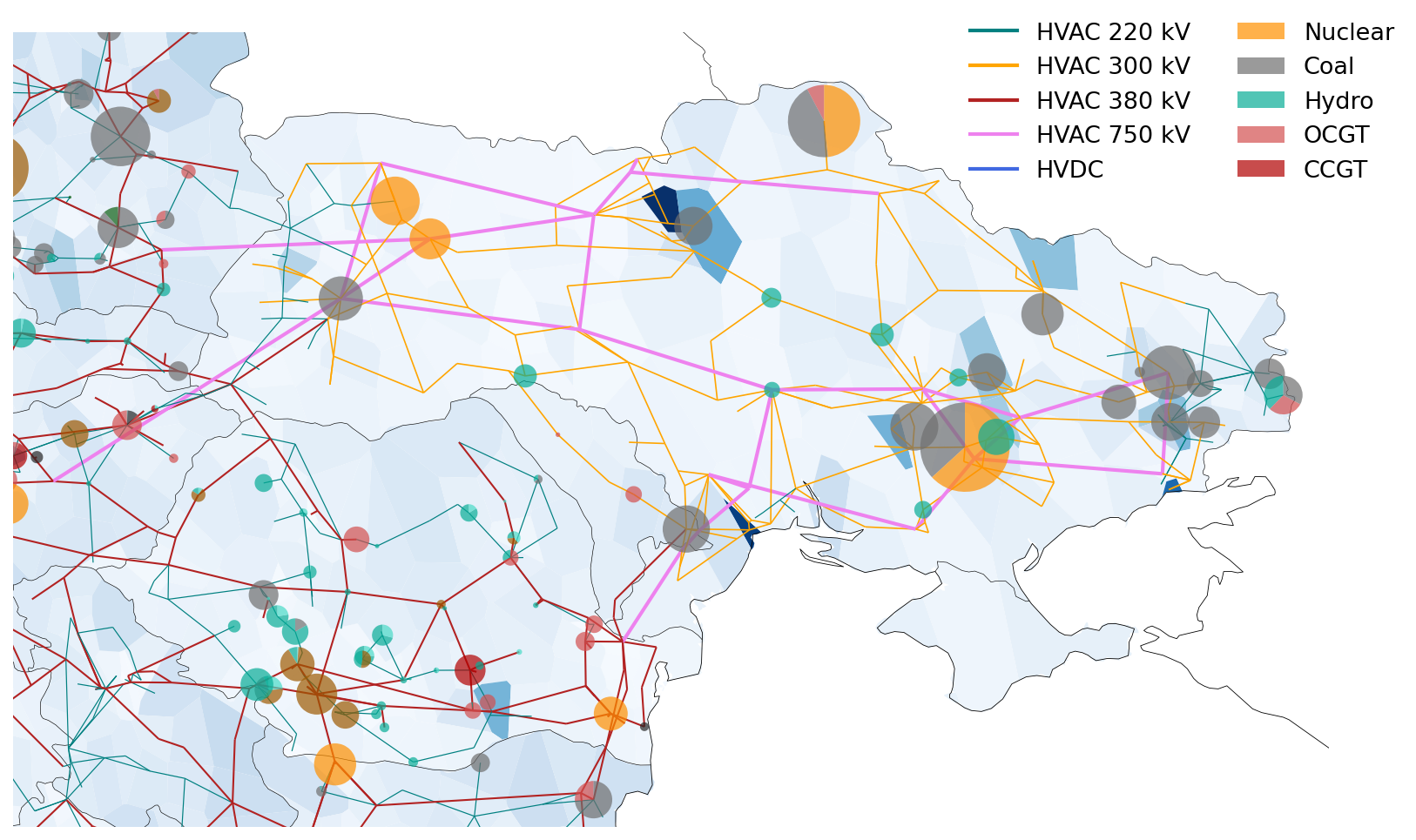
the transmission network topology from the ENTSO-E interactive map.
existing power plants (incl. nuclear, coal, gas and hydro) from the powerplantmatching tool
country-level load time series from ENTSO-E through the OPSD platform, which are then distributed heuristically to substations by GDP and population density.
wind and solar profiles based on ERA5 and SARAH-2 weather data
hydro profiles based on historical EIA generation data
a simplified calculation of wind and solar potentials based on the Copernicus Land Cover dataset.
electrical characteristics of 750 kV transmission lines
The Crimean power system is currently disconnected from the main Ukrainian grid and, hence, not included.
This release is not on the master branch. It can be used with
git clone https://github.com/pypsa/pypsa-eur
git checkout synchronisation-release
PyPSA-Eur 0.4.0 (22th September 2021)#
New Features and Changes
With this release, we change the license from copyleft GPLv3 to the more liberal MIT license with the consent of all contributors [#276].
Switch to the new major
atliterelease v0.2. The version upgrade comes along with significant speed up for the rulebuild_renewable_profiles.py(~factor 2). A lot of the code which calculated the land-use availability is now outsourced and does not rely onglaes,geokitanymore. This facilitates the environment building and version compatibility ofgdal,libgdalwith other packages [#224].Implemented changes to
n.snapshot_weightingsin new PyPSA version v0.18 (cf. PyPSA/PyPSA/#227) [#259].Add option to pre-aggregate nodes without power injections (positive or negative, i.e. generation or demand) to electrically closest nodes or neighbors in
simplify_network. Defaults toFalse. This affects nodes that are no substations or have no offshore connection.In
simplify_network, bus columns with no longer correct entries are removed (symbol, tags, under_construction, substation_lv, substation_off) [#219]Add option to include marginal costs of links representing fuel cells, electrolysis, and battery inverters [#232].
The rule and script
build_country_flhare removed as they are no longer used or maintained.The connection cost of generators in
simplify_networkare now reported inresources/connection_costs_s{simpl}.csv[#261].The tutorial cutout was renamed from
cutouts/europe-2013-era5.nctocutouts/be-03-2013-era5.ncto accommodate tutorial and productive cutouts side-by-side.The flag
keep_all_available_areasin the configuration for renewable potentials was deprecated and now defaults toTrue.Update dependencies in
envs/environment.yaml[#257]Continuous integration testing switches to Github Actions from Travis CI [#252].
Documentation on readthedocs.io is now built with
piponly and no longer requiresconda[#267].Use
Citation.cff[#273].
Bugs and Compatibility
Support for PyPSA v0.18 [#268].
Minimum Python version set to
3.8.Removed
sixdependency [#245].Update
plot_networkandmake_summaryrules to latest PyPSA versions [#270].Keep converter links to store components when using the
ATKwildcard and only remove DC links [#214].Value for
co2baseinconfig.yamladjusted to 1.487e9 t CO2-eq (from 3.1e9 t CO2-eq). The new value represents emissions related to the electricity sector for EU+UK+Balkan. The old value was too high and used when the emissions wildcard in{opts}was used [#233].Add escape in
base_networkif all TYNDP links are already contained in the network [#246].In
solve_operations_networkthe optimised capacities are now fixed for all extendable links, not only HVDC links [#244].The
focus_weightsare now also considered when pre-clustering in thesimplify_networkrule [#241].in
build_renewable_profilewhere offshore wind profiles could no longer be created [#249].Lower expansion limit of extendable carriers is now set to the existing capacity, i.e.
p_nom_min = p_nom(0 before). Simultaneously, the upper limit (p_nom_max) is now the maximum of the installed capacity (p_nom) and the previous estimate based on land availability (p_nom_max) [#260].Solving an operations network now includes optimized store capacities as well. Before only lines, links, generators and storage units were considered [#269].
With
load_shedding: truein the solving options ofconfig.yamlload shedding generators are only added at the AC buses, excluding buses for H2 and battery stores [#269].Delete duplicated capital costs at battery discharge link [#240].
Propagate the solver log file name to the solver. Previously, the PyPSA network solving functions were not told about the solver logfile specified in the Snakemake file [#247]
PyPSA-Eur 0.3.0 (7th December 2020)#
New Features
Using the {opts} wildcard for scenario:
An option is introduced which adds constraints such that each country or node produces on average a minimal share of its total consumption itself. For example
EQ0.5cset in the{opts}wildcard requires each country to produce on average at least 50% of its consumption. Additionally, the optionATKrequires autarky at each node and removes all means of power transmission through lines and links.ATKconly removes cross-border transfer capacities. [#166].Added an option to alter the capital cost (
c) or installable potentials (p) of carriers by a factor viacarrier+{c,p}factorin the{opts}wildcard. This can be useful for exploring uncertain cost parameters. Example:solar+c0.5reduces the capital cost of solar to 50% of original values [#167, #207].Added an option to the
{opts}wildcard that applies a time series segmentation algorithm based on renewables, hydro inflow and load time series to produce a given total number of adjacent snapshots of varying lengths. This feature is an alternative to downsampling the temporal resolution by simply averaging and uses the tsam package [#186].
More OPSD integration:
Add renewable power plants from OPSD to the network for specified technologies. This will overwrite the capacities calculated from the heuristic approach in
estimate_renewable_capacities()[#212].Electricity consumption data is now retrieved directly from the OPSD website using the rule
build_electricity_demand. The user can decide whether to take the ENTSO-E power statistics data (default) or the ENTSO-E transparency data [#211].
Other:
Added an option to use custom busmaps in rule
cluster_network. To use this feature setenable: custom_busmap: true. Then, the rule looks for custom busmaps atdata/custom_busmap_elec_s{simpl}_{clusters}.csv, which should have the same format asresources/busmap_elec_s{simpl}_{clusters}.csv. i.e. the index should contain the buses ofnetworks/elec_s{simpl}.nc[#193].Line and link capacities can be capped in the
config.yamlatlines: s_nom_max:andlinks: p_nom_max: [#166].Added Google Cloud Platform tutorial (for Windows users) [#177].
Changes
Don’t remove capital costs from lines and links, when imposing a line volume limit (
lv) or a line cost limit (lc). Previously, these were removed to move the expansion in direction of the limit [#183].The mappings for clustered lines and buses produced by the
simplify_networkandcluster_networkrules changed from Hierarchical Data Format (.h5) to Comma-Separated Values format (.csv) for ease of use. [#198]The N-1 security margin for transmission lines is now fixed to a provided value in
config.yaml, removing an undocumented linear interpolation between 0.5 and 0.7 in the range between 37 and 200 nodes. [#199].Modelling hydrogen and battery storage with Store and Link components is now the default, rather than using StorageUnit components with fixed power-to-energy ratio [#205].
Use
mamba(mamba-org/mamba) for faster Travis CI builds [#196].Multiple smaller changes: Removed unused
{network}wildcard, moved environment files to dedicatedenvsfolder, removed sector-coupling components from configuration files, updated documentation colors, minor refactoring and code cleaning [#190].
Bugs and Compatibility
Add compatibility for pyomo 5.7.0 in
cluster_networkandsimplify_network[#172].Fixed a bug for storage units such that individual store and dispatch efficiencies are correctly taken account of rather than only their round-trip efficiencies. In the cost database (
data/costs.csv) the efficiency of battery inverters should be stated as per discharge/charge rather than per roundtrip [#202].Corrected exogenous emission price setting (in
config: cost: emission price:), which now correctly accounts for the efficiency and effective emission of the generators [#171].Corrected HVDC link connections (a) between Norway and Denmark and (b) mainland Italy, Corsica (FR) and Sardinia (IT) as well as for East-Western and Anglo-Scottish interconnectors [#181, #206].
Fix bug of clustering
offwind-{ac,dc}generators in the option of high-resolution generators for renewables. Now, there are more sites foroffwind-{ac,dc}available than network nodes. Before, they were clustered to the resolution of the network (elec_s1024_37m.nc: 37 network nodes, 1024 generators) [#191].Raise a warning if
tech_colorsin the config are not defined for all carriers [#178].
PyPSA-Eur 0.2.0 (8th June 2020)#
The optimization is now performed using the
pyomo=Falsesetting in thepypsa.lopf.network_lopf(). This speeds up the solving process significantly and consumes much less memory. The inclusion of additional constraints were adjusted to the new implementation. They are all passed to thenetwork_lopf()function via theextra_functionalityargument. The ruletrace_solve_networkwas integrated into the rulesolve_networkand can be activated via configuration withsolving: options: track_iterations: true. The charging and discharging capacities of batteries modelled as store-link combination are now coupled [#116].An updated extract of the ENTSO-E Transmission System Map (including Malta) was added to the repository using the GridKit tool. This tool has been updated to retrieve up-to-date map extracts using a single script. The update extract features 5322 buses, 6574 lines, 46 links. [#118].
Added FSFE REUSE compliant license information. Documentation now licensed under CC-BY-4.0 [#160].
Added a 30 minute video introduction and a 20 minute video tutorial
Networks now store a color and a nicely formatted name for each carrier, accessible via
n.carrier['color']andn.carrier['nice_name'] ``(networks after ``elec.nc).Added an option to skip iterative solving usually performed to update the line impedances of expanded lines at
solving: options: skip_iterations:.snakemakerules for retrieving cutouts and the natura raster can now be disabled independently from their respective rules to build them; viaconfig.*yaml[#136].Removed the
idcolumn for custom power plants indata/custom_powerplants.csvto avoid custom power plants with conflicting ids getting attached to the wrong bus [#131].Add option
renewables: {carrier}: keep_all_available_areas:to use all available weather cells for renewable profile and potential generation. The default ignores weather cells where only less than 1 MW can be installed [#150].Added a function
_helpers.load_network()which loads a network with overridden components specified insnakemake.config['override_components'][#128].Bugfix in
base_networkwhich now finds all closest links, not only the first entry [#143].Bugfix in
cluster_networkwhich now skips recalculation of link parameters if there are no links [#149].Added information on pull requests to contribution guidelines [#151].
Improved documentation on open-source solver setup and added usage warnings.
Updated
condaenvironment regardingpypsa,pyproj,gurobi,lxml. This release requires PyPSA v0.17.0.
PyPSA-Eur 0.1.0 (9th January 2020)#
This is the first release of PyPSA-Eur, a model of the European power system at the transmission network level. Recent changes include:
Documentation on installation, workflows and configuration settings is now available online at pypsa-eur.readthedocs.io [#65].
The
condaenvironment files were updated and extended [#81].The power plant database was updated with extensive filtering options via
pandas.queryfunctionality [#84 and #94].Continuous integration testing with Travis CI is now included for Linux, Mac and Windows [#82].
Data dependencies were moved to zenodo and are now versioned [#60].
Data dependencies are now retrieved directly from within the snakemake workflow [#86].
Emission prices can be added to marginal costs of generators through the keywords
Epin the{opts}wildcard [#100].An option is introduced to add extendable nuclear power plants to the network [#98].
Focus weights can now be specified for particular countries for the network clustering, which allows to set a proportion of the total number of clusters for particular countries [#87].
A new rule
add_extra_componentsallows to add additional components to the network only after clustering. It is thereby possible to model storage units (e.g. battery and hydrogen) in more detail via a combination ofStore,LinkandBuselements [#97].Hydrogen pipelines (including cost assumptions) can now be added alongside clustered network connections in the rule
add_extra_components. Setelectricity: extendable_carriers: Link: [H2 pipeline]and ensure hydrogen storage is modelled as aStore. This is a first simplified stage [#108].Logfiles for all rules of the
snakemakeworkflow are now written in the folderlog/[#102].The new function
_helpers.mock_snakemakecreates asnakemakeobject which mimics the actualsnakemakeobject produced by workflow by parsing theSnakefileand setting all paths for inputs, outputs, and logs. This allows running all scripts within a (I)python terminal (or just by callingpython <script-name>) and thereby facilitates developing and debugging scripts significantly [#107].
PyPSA-Eur-Sec Releases (pre-merge)#
PyPSA-Eur-Sec 0.7.0 (16th February 2023)#
This release includes many new features. Highlights include new gas infrastructure data with retrofitting options for hydrogen transport, improved carbon management and infrastructure planning, regionalised potentials for hydrogen underground storage and carbon sequestration, new applications for biomass, and explicit modelling of methanol and ammonia as separate energy carriers.
This release is known to work with PyPSA-Eur Version 0.7.0 and Technology Data Version 0.5.0.
Gas Transmission Network
New rule
retrieve_gas_infrastructure_datathat downloads and extracts the SciGRID_gas IGGIELGN dataset from zenodo. It includes data on the transmission routes, pipe diameters, capacities, pressure, and whether the pipeline is bidirectional and carries H-Gas or L-Gas.New rule
build_gas_networkprocesses and cleans the pipeline data from SciGRID_gas. Missing or uncertain pipeline capacities can be inferred by diameter.New rule
build_gas_input_locationscompiles the LNG import capacities (from the Global Energy Monitor’s Europe Gas Tracker, pipeline entry capacities and local production capacities for each region of the model. These are the regions where fossil gas can eventually enter the model.New rule
cluster_gas_networkthat clusters the gas transmission network data to the model resolution. Cross-regional pipeline capacities are aggregated (while pressure and diameter compatibility is ignored), intra-regional pipelines are dropped. Lengths are recalculated based on the regions’ centroids.With the option
sector: gas_network:, the existing gas network is added with a lossless transport model. A length-weighted k-edge augmentation algorithm can be run to add new candidate gas pipelines such that all regions of the model can be connected to the gas network. The number of candidates can be controlled via the settingsector: gas_network_connectivity_upgrade:. When the gas network is activated, all the gas demands are regionally disaggregated as well.New constraint allows endogenous retrofitting of gas pipelines to hydrogen pipelines. This option is activated via the setting
sector: H2_retrofit:. For every unit of gas pipeline capacity dismantled,sector: H2_retrofit_capacity_per_CH4units are made available as hydrogen pipeline capacity in the corresponding corridor. These repurposed hydrogen pipelines have lower costs than new hydrogen pipelines. Both new and repurposed pipelines can be built simultaneously. The retrofitting optionsector: H2_retrofit:also works with a copperplated methane infrastructure, i.e. whensector: gas_network: false.New hydrogen pipelines can now be built where there are already power or gas transmission routes. Previously, only the electricity transmission routes were considered.
Carbon Management and Biomass
Add option to spatially resolve carrier representing stored carbon dioxide (
co2_spatial). This allows for more detailed modelling of CCUTS, e.g. regarding the capturing of industrial process emissions, usage as feedstock for electrofuels, transport of carbon dioxide, and geological sequestration sites.Add option for regionally-resolved geological carbon dioxide sequestration potentials through new rule
build_sequestration_potentialsbased on CO2StoP. This can be controlled in the sectionregional_co2_sequestration_potentialof theconfig.yaml. It includes options to select the level of conservatism, whether onshore potentials should be included, the respective upper and lower limits per region, and an annualisation parameter for the cumulative potential. The defaults are preliminary and will be validated the next release.Add option to sweep the global CO2 sequestration potentials with keyword
seq200in the{sector_opts}wildcard (for limit of 200 Mt CO2).Add option to include Allam cycle gas power plants (
allam_cycle).Add option for planning a new carbon dioxide network (
co2network).Separate option to regionally resolve biomass (
biomass_spatial) from option to allow biomass transport (biomass_transport).Add option for biomass boilers (wood pellets) for decentral heating.
Add option for BioSNG (methane from biomass) with and without carbon capture.
Add option for BtL (biomass to liquid fuel/oil) with and without carbon capture.
Other new features
Add regionalised hydrogen salt cavern storage potentials from Technical Potential of Salt Caverns for Hydrogen Storage in Europe. This data is compiled in a new rule
build_salt_cavern_potentials.Add option to resolve ammonia as separate energy carrier with Haber-Bosch synthesis, ammonia cracking, storage and industrial demand. The ammonia carrier can be nodally resolved or copperplated across Europe (see
ammonia).Add methanol as energy carrier, methanolisation as process, and option for methanol demand in shipping sector.
Shipping demand now defaults to methanol rather than liquefied hydrogen until 2050.
Demand for liquid hydrogen in international shipping is now geographically distributed by port trade volumes in a new rule
build_shipping_demandusing data from the World Bank Data Catalogue. Domestic shipping remains distributed by population.Add option to aggregate network temporally using representative snapshots or segments (with tsam).
Add option for minimum part load for Fischer-Tropsch plants (default: 90%) and methanolisation plants (default: 50%).
Add option to use waste heat of electrolysis in district heating networks (
use_electrolysis_waste_heat).Add option for coal CHPs with carbon capture (see
coal_cc).In overnight optimisation, it is now possible to specify a year for the technology cost projections separate from the planning horizon.
New config options for changing energy demands in aviation (
aviation_demand_factor) and HVC industry (HVC_demand_factor), as well as explicit ICE shares for land transport (land_transport_ice_share) and agriculture machinery (agriculture_machinery_oil_share).It is now possible to merge residential and services heat buses to reduce the problem size (see
cluster_heat_nodes).Added option to tweak (almost) any configuration parameter through the
{sector_opts}wildcard. The regional_co2_sequestration_potential is triggered by the prefixCF+after which it is possible to pipe to any setting that does not contain underscores (_). Example:CF+sector+v2g+falsedisables vehicle-to-grid flexibility.Option
retrieve_sector_databundleto automatically retrieve and extract data bundle.Removed the need to clone
technology-datarepository in a parallel directory. The new approach automatically retrieves the technology data from remote in the ruleretrieve_cost_data.Improved network plots including better legends, hydrogen retrofitting network display, and change to EqualEarth projection. A new color scheme for technologies was also introduced.
Add two new rules
build_transport_demandandbuild_population_weighted_energy_totalsusing code previously contained inprepare_sector_network.Rules that convert weather data with
atlitenow largely run separately for categories residential, rural and total.Units are assigned to the buses. These only provide a better understanding. The specifications of the units are not taken into account in the optimisation, which means that no automatic conversion of units takes place.
Configuration file and wildcards are now stored under
n.metain every PyPSA network.Updated data bundle that includes the hydrogan salt cavern storage potentials.
Updated and extended documentation in <https://pypsa-eur-sec.readthedocs.io/en/latest/>
Added new rule
copy_conda_envthat exports a list of packages with which the workflow was executed.Add basic continuous integration using Github Actions.
Add basic
rsyncsetup.
Bugfixes
The CO2 sequestration limit implemented as GlobalConstraint (introduced in the previous version) caused a failure to read in the shadow prices of other global constraints.
Correct capital cost of Fischer-Tropsch according to new units in
technology-datarepository.Fix unit conversion error for thermal energy storage.
For myopic pathway optimisation, set optimised capacities of power grid expansion of previous iteration as minimum capacity for next iteration.
Further rather minor bugfixes for myopic optimisation code (see #256).
Many thanks to all who contributed to this release!
PyPSA-Eur-Sec 0.6.0 (4 October 2021)#
This release includes improvements regarding the basic chemical production, the addition of plastics recycling, the addition of the agriculture, forestry and fishing sector, more regionally resolved biomass potentials, CO2 pipeline transport and storage, and more options in setting exogenous transition paths, besides many performance improvements.
This release is known to work with PyPSA-Eur Version 0.4.0, Technology Data Version 0.3.0 and PyPSA Version 0.18.0.
Please note that the data bundle has also been updated.
General
With this release, we change the license from copyleft GPLv3 to the more liberal MIT license with the consent of all contributors.
New features and functionality
Distinguish costs for home battery storage and inverter from utility-scale battery costs.
Separate basic chemicals into HVC (high-value chemicals), chlorine, methanol and ammonia [#166].
Add option to specify reuse, primary production, and mechanical and chemical recycling fraction of platics [#166].
Include energy demands and CO2 emissions for the agriculture, forestry and fishing sector. It is included by default through the option
Ain thesector_optswildcard. Part of the emissions (1.A.4.c) was previously assigned to “industry non-elec” in theco2_totals.csv. Hence, excluding the agriculture sector will now lead to a tighter CO2 limit. Energy demands are taken from the JRC IDEES database (missing countries filled with eurostat data) and are split into electricity (lighting, ventilation, specific electricity uses, pumping devices (electric)), heat (specific heat uses, low enthalpy heat) machinery oil (motor drives, farming machine drives, pumping devices (diesel)). Heat demand is assigned at “services rural heat” buses. Electricity demands are added to low-voltage buses. Time series for demands are constant and distributed inside countries by population [#147].Include today’s district heating shares in myopic optimisation and add option to specify exogenous path for district heating share increase under
sector: district_heating:[#149].Added option for hydrogen liquefaction costs for hydrogen demand in shipping. This introduces a new
H2 liquidbus at each location. It is activated viasector: shipping_hydrogen_liquefaction: true.The share of shipping transformed into hydrogen fuel cell can be now defined for different years in the
config.yamlfile. The carbon emission from the remaining share is treated as a negative load on the atmospheric carbon dioxide bus, just like aviation and land transport emissions.The transformation of the Steel and Aluminium production can be now defined for different years in the
config.yamlfile.Include the option to alter the maximum energy capacity of a store via the
carrier+factorin the{sector_opts}wildcard. This can be useful for sensitivity analyses. Example:co2 stored+e2multiplies thee_nom_maxby factor 2. In this example,e_nom_maxrepresents the CO2 sequestration potential in Europe.Use JRC ENSPRESO database to spatially disaggregate biomass potentials to PyPSA-Eur regions based on overlaps with NUTS2 regions from ENSPRESO (proportional to area) (#151).
Add option to regionally disaggregate biomass potential to individual nodes (previously given per country, then distributed by population density within) and allow the transport of solid biomass. The transport costs are determined based on the JRC-EU-Times Bioenergy report in the new optional rule
build_biomass_transport_costs. Biomass transport can be activated with the settingsector: biomass_transport: true.Add option to regionally resolve CO2 storage and add CO2 pipeline transport because geological storage potential, CO2 utilisation sites and CO2 capture sites may be separated. The CO2 network is built from zero based on the topology of the electricity grid (greenfield). Pipelines are assumed to be bidirectional and lossless. Furthermore, neither retrofitting of natural gas pipelines (required pressures are too high, 80-160 bar vs <80 bar) nor other modes of CO2 transport (by ship, road or rail) are considered. The regional representation of CO2 is activated with the config setting
sector: co2_network: truebut is deactivated by default. The global limit for CO2 sequestration now applies to the sum of all CO2 stores via anextra_functionalityconstraint.The myopic option can now be used together with different clustering for the generators and the network. The existing renewable capacities are split evenly among the regions in every country [#144].
Add optional function to use
geopyto locate entries of the Hotmaps database of industrial sites with missing location based on city and country, which reduces missing entries by half. It can be activated by settingindustry: hotmaps_locate_missing: true, takes a few minutes longer, and should only be used if spatial resolution is coarser than city level.
Performance and Structure
Extended use of
multiprocessingfor much better performance (from up to 20 minutes to less than one minute).Handle most input files (or base directories) via
snakemake.input.Use of
mock_snakemakefrom PyPSA-Eur.Update
solve_networkrule to match implementation in PyPSA-Eur by usingn.ilopf()and remove outdated code usingpyomo. Allows the new setting to skip iterated impedance updates withsolving: options: skip_iterations: true.The component attributes that are to be overridden are now stored in the folder
data/override_component_attrsanalogous topypsa/component_attrs. This reduces verbosity and also allows circumventing then.madd()hack for individual components with non-default attributes. This data is also tracked in the Snakefile. A functionhelper.override_component_attrswas added that loads this data and can pass the overridden component attributes intopypsa.Network().Add various parameters to
config.default.yamlwhich were previously hardcoded inside the scripts (e.g. energy reference years, BEV settings, solar thermal collector models, geomap colours).Removed stale industry demand rules
build_industrial_energy_demand_per_countryandbuild_industrial_demand. These are superseded with more regionally resolved rules.Use simpler and shorter
gdf.sjoin()function to allocate industrial sites from the Hotmaps database to onshore regions. This change also fixes a bug: The previous version allocated sites to the closest bus, but at country borders (where Voronoi cells are distorted by the borders), this had resulted in e.g. a Spanish site close to the French border being wrongly allocated to the French bus if the bus center was closer.Retrofitting rule is now only triggered if endogeneously optimised.
Show progress in build rules with
tqdmprogress bars.Reduced verbosity of
Snakefilethrough directory prefixes.Improve legibility of
config.default.yamland remove unused options.Use the country-specific time zone mappings from
pytzrather than a manual mapping.A function
add_carrier_buses()was added to theprepare_networkrule to reduce code duplication.In the
prepare_networkrule the cost and potential adjustment was moved into an own functionmaybe_adjust_costs_and_potentials().Use
matplotlibrcto set the default plotting style and backend.Added benchmark files for each rule.
Consistent use of
__main__block and further unspecific code cleaning.Updated data bundle and moved data bundle to zenodo.org (10.5281/zenodo.5546517).
Bugfixes and Compatibility
Compatibility with
atlite>=0.2. Older versions ofatlitewill no longer work.Corrected calculation of “gas for industry” carbon capture efficiency.
Implemented changes to
n.snapshot_weightingsin PyPSA v0.18.0.Compatibility with
xarrayversion 0.19.New dependencies:
tqdm,atlite>=0.2.4,pytzandgeopy(optional). These are included in the environment specifications of PyPSA-Eur v0.4.0.
Many thanks to all who contributed to this release!
PyPSA-Eur-Sec 0.5.0 (21st May 2021)#
This release includes improvements to the cost database for building retrofits, carbon budget management and wildcard settings, as well as an important bugfix for the emissions from land transport.
This release is known to work with PyPSA-Eur Version 0.3.0 and Technology Data Version 0.2.0.
Please note that the data bundle has also been updated.
New features and bugfixes:
The cost database for retrofitting of the thermal envelope of buildings has been updated. Now, for calculating the space heat savings of a building, losses by thermal bridges and ventilation are included as well as heat gains (internal and by solar radiation). See the section retro for more details on the retrofitting module.
For the myopic investment option, a carbon budget and a type of decay (exponential or beta) can be selected in the
config.yamlfile to distribute the budget across theplanning_horizons. For example,cb40ex0in the{sector_opts}wildcard will distribute a carbon budget of 40 GtCO2 following an exponential decay with initial growth rate 0.Added an option to alter the capital cost or maximum capacity of carriers by a factor via
carrier+factorin the{sector_opts}wildcard. This can be useful for exploring uncertain cost parameters. Example:solar+c0.5reduces thecapital_costof solar to 50% of original values. Similarlysolar+p3multiplies thep_nom_maxby 3.Rename the bus for European liquid hydrocarbons from
Fischer-TropschtoEU oil, since it can be supplied not just with the Fischer-Tropsch process, but also with fossil oil.Bugfix: The new separation of land transport by carrier in Version 0.4.0 failed to account for the carbon dioxide emissions from internal combustion engines in land transport. This is now treated as a negative load on the atmospheric carbon dioxide bus, just like aviation emissions.
Bugfix: Fix reading in of
pypsa-eur/resources/powerplants.csvto PyPSA-Eur Version 0.3.0 (use column attribute nameDateIninstead of oldYearDecommissioned).Bugfix: Make sure that
Storecomponents (battery and H2) are also removed from PyPSA-Eur, so they can be added later by PyPSA-Eur-Sec.
Thanks to Lisa Zeyen (KIT) for the retrofitting improvements and Marta Victoria (Aarhus University) for the carbon budget and wildcard management.
PyPSA-Eur-Sec 0.4.0 (11th December 2020)#
This release includes a more accurate nodal disaggregation of industry demand within each country, fixes to CHP and CCS representations, as well as changes to some configuration settings.
It has been released to coincide with PyPSA-Eur Version 0.3.0 and Technology Data Version 0.2.0, and is known to work with these releases.
New features:
The Hotmaps Industrial Database is used to disaggregate the industrial demand spatially to the nodes inside each country (previously it was distributed by population density).
Electricity demand from industry is now separated from the regular electricity demand and distributed according to the industry demand. Only the remaining regular electricity demand for households and services is distributed according to GDP and population.
A cost database for the retrofitting of the thermal envelope of residential and services buildings has been integrated, as well as endogenous optimisation of the level of retrofitting. This is described in the paper Mitigating heat demand peaks in buildings in a highly renewable European energy system. Retrofitting can be activated both exogenously and endogenously from the
config.yaml.The biomass and gas combined heat and power (CHP) parameters
c_vandc_bwere read in assuming they were extraction plants rather than back pressure plants. The data is now corrected in Technology Data Version 0.2.0 to the correct DEA back pressure assumptions and they are now implemented as single links with a fixed ratio of electricity to heat output (even as extraction plants, they were always sitting on the backpressure line in simulations, so there was no point in modelling the full heat-electricity feasibility polygon). The old assumptions underestimated the heat output.The Danish Energy Agency released new assumptions for carbon capture in October 2020, which have now been incorporated in PyPSA-Eur-Sec, including direct air capture (DAC) and post-combustion capture on CHPs, cement kilns and other industrial facilities. The electricity and heat demand for DAC is modelled for each node (with heat coming from district heating), but currently the electricity and heat demand for industrial capture is not modelled very cleanly (for process heat, 10% of the energy is assumed to go to carbon capture) - a new issue will be opened on this.
Land transport is separated by energy carrier (fossil, hydrogen fuel cell electric vehicle, and electric vehicle), but still needs to be separated into heavy and light vehicles (the data is there, just not the code yet).
For assumptions that change with the investment year, there is a new time-dependent format in the
config.yamlusing a dictionary with keys for each year. Implemented examples include the CO2 budget, exogenous retrofitting share and land transport energy carrier; more parameters will be dynamised like this in future.Some assumptions have been moved out of the code and into the
config.yaml, including the carbon sequestration potential and cost, the heat pump sink temperature, reductions in demand for high value chemicals, and some BEV DSM parameters and transport efficiencies.Documentation on Supply and demand options has been added.
Many thanks to Fraunhofer ISI for opening the hotmaps database and to Lisa Zeyen (KIT) for implementing the building retrofitting.
PyPSA-Eur-Sec 0.3.0 (27th September 2020)#
This releases focuses on improvements to industry demand and the generation of intermediate files for demand for basic materials. There are still inconsistencies with CCS and waste management that need to be improved.
It is known to work with PyPSA-Eur v0.1.0 (commit bb3477cd69), PyPSA v0.17.1 and technology-data v0.1.0. Please note that the data bundle has also been updated.
New features:
In previous version of PyPSA-Eur-Sec the energy demand for industry was calculated directly for each location. Now, instead, the production of each material (steel, cement, aluminium) at each location is calculated as an intermediate data file, before the energy demand is calculated from it. This allows us in future to have competing industrial processes for supplying the same material demand.
The script
build_industrial_production_per_country_tomorrow.pydetermines the future industrial production of materials based on today’s levels as well as assumed recycling and demand change measures.The energy demand for each industry sector and each location in 2015 is also calculated, so that it can be later incorporated in the pathway optimization.
Ammonia production data is taken from the USGS and deducted from JRC-IDEES’s “basic chemicals” so that it ammonia can be handled separately from the others (olefins, aromatics and chlorine).
Solid biomass is no longer allowed to be used for process heat in cement and basic chemicals, since the wastes and residues cannot be guaranteed to reach the high temperatures required. Instead, solid biomass is used in the paper and pulp as well as food, beverages and tobacco industries, where required temperatures are lower (see DOI:10.1002/er.3436 and DOI:10.1007/s12053-017-9571-y).
National installable potentials for salt caverns are now applied.
When electricity distribution grids are activated, new industry electricity demand, resistive heaters and micro-CHPs are now connected to the lower voltage levels.
Gas distribution grid costs are included for gas boilers and micro-CHPs.
Installable potentials for rooftop PV are included with an assumption of 1 kWp per person.
Some intermediate files produced by scripts have been moved from the folder
datato the folderresources. Nowdataonly includes input data, whileresourcesonly includes intermediate files necessary for building the network models. Please note that the data bundle has also been updated.Biomass potentials for different years and scenarios from the JRC are generated in an intermediate file, so that a selection can be made more explicitly by specifying the biomass types from the
config.yaml.
PyPSA-Eur-Sec 0.2.0 (21st August 2020)#
This release introduces pathway optimization over many years (e.g. 2020, 2030, 2040, 2050) with myopic foresight, as well as outsourcing the technology assumptions to the technology-data repository.
It is known to work with PyPSA-Eur v0.1.0 (commit bb3477cd69), PyPSA v0.17.1 and technology-data v0.1.0.
New features:
Option for pathway optimization with myopic foresight, based on the paper Early decarbonisation of the European Energy system pays off (2020). Investments are optimized sequentially for multiple years (e.g. 2020, 2030, 2040, 2050) taking account of existing assets built in previous years and their lifetimes. The script uses data on the existing assets for electricity and building heating technologies, but there are no assumptions yet for existing transport and industry (if you include these, the model will greenfield them). There are also some outstanding issues on e.g. the distribution of existing wind, solar and heating technologies within each country. To use myopic foresight, set
foresight : 'myopic'in theconfig.yamlinstead of the defaultforesight : 'overnight'. An example configuration can be found inconfig.myopic.yaml. More details on the implementation can be found in myopic.Technology assumptions (costs, efficiencies, etc.) are no longer stored in the repository. Instead, you have to install the technology-data database in a parallel directory. These assumptions are largely based on the Danish Energy Agency Technology Data. More details on the installation can be found in Installation.
Logs and benchmarks are now stored with the other model outputs in
results/run-name/.All buses now have a
locationattribute, e.g. busDE0 3 urban central heathas alocationofDE0 3.All assets have a
lifetimeattribute (integer in years). For the myopic foresight, abuild_yearattribute is also stored.Costs for solar and onshore and offshore wind are recalculated by PyPSA-Eur-Sec based on the investment year, including the AC or DC connection costs for offshore wind.
Many thanks to Marta Victoria for implementing the myopic foresight, and Marta Victoria, Kun Zhu and Lisa Zeyen for developing the technology assumptions database.
PyPSA-Eur-Sec 0.1.0 (8th July 2020)#
This is the first proper release of PyPSA-Eur-Sec, a model of the European energy system at the transmission network level that covers the full ENTSO-E area.
It is known to work with PyPSA-Eur v0.1.0 (commit bb3477cd69) and PyPSA v0.17.0.
We are making this release since in version 0.2.0 we will introduce changes to allow myopic investment planning that will require minor changes for users of the overnight investment planning.
PyPSA-Eur-Sec builds on the electricity generation and transmission model PyPSA-Eur to add demand and supply for the following sectors: transport, space and water heating, biomass, industry and industrial feedstocks. This completes the energy system and includes all greenhouse gas emitters except waste management, agriculture, forestry and land use.
PyPSA-Eur-Sec was initially based on the model PyPSA-Eur-Sec-30 (Version 0.0.1 below) described in the paper Synergies of sector coupling and transmission reinforcement in a cost-optimised, highly renewable European energy system (2018) but it differs by being based on the higher resolution electricity transmission model PyPSA-Eur rather than a one-node-per-country model, and by including biomass, industry, industrial feedstocks, aviation, shipping, better carbon management, carbon capture and usage/sequestration, and gas networks.
PyPSA-Eur-Sec includes PyPSA-Eur as a snakemake subworkflow. PyPSA-Eur-Sec uses PyPSA-Eur to build the clustered transmission model along with wind, solar PV and hydroelectricity potentials and time series. Then PyPSA-Eur-Sec adds other conventional generators, storage units and the additional sectors.
PyPSA-Eur-Sec 0.0.2 (4th September 2020)#
This version, also called PyPSA-Eur-Sec-30-Path, built on PyPSA-Eur-Sec 0.0.1 (also called PyPSA-Eur-Sec-30) to include myopic pathway optimisation for the paper Early decarbonisation of the European energy system pays off (2020). The myopic pathway optimisation was then merged into the main PyPSA-Eur-Sec codebase in Version 0.2.0 above.
This model has its own github repository and is archived on Zenodo.
PyPSA-Eur-Sec 0.0.1 (12th January 2018)#
This is the first published version of PyPSA-Eur-Sec, also called PyPSA-Eur-Sec-30. It was first used in the research paper Synergies of sector coupling and transmission reinforcement in a cost-optimised, highly renewable European energy system (2018). The model covers 30 European countries with one node per country. It includes demand and supply for electricity, space and water heating in buildings, and land transport.
It is archived on Zenodo.
Release Process#
Checkout a new release branch
git checkout -b release-v0.x.x.Finalise release notes at
doc/release_notes.rst.Update
envs/environment.fixed.yamlviaconda env export -n pypsa-eur -f envs/environment.fixed.yaml --no-buildsfrom an up-to-datepypsa-eurenvironment.Update version number in
doc/conf.py,CITATION.cffand*config.*.yaml.Make a
git commit.Open, review and merge pull request for branch
release-v0.x.x. Make sure to close issues and PRs or the release milestone with it (e.g. closes #X).Tag a release on Github via
git tag v0.x.x,git push,git push --tags. Include release notes in the tag message.Make a GitHub release, which automatically triggers archiving to the zenodo code repository with MIT license.
Send announcement on the PyPSA mailing list.